

72% of support teams still rely on sampled tickets, survey scores, or dashboard exports to explain customer sentiment. You felt this this week if someone asked, "why are customers frustrated?" and the honest answer was a mix of guesses, a few screenshots, and one loud anecdote.
Understanding customer sentiment through surveys alone sounds responsible. It usually isn't. Same thing with sampled ticket reviews. You get the comfort of a number, not the truth behind it.
Key Takeaways:
- Understanding customer sentiment through support conversations works better when you analyze 100% of tickets, not a sample.
- If a trend can't be traced back to exact tickets and quotes, it will get challenged in leadership meetings.
- CSAT, NPS, and basic sentiment scores can show movement, but they rarely explain why sentiment changed.
- A useful sentiment system needs three layers: coverage, structure, and traceability.
- You don't need a new helpdesk to do this well. An intelligence layer on top of Zendesk or a CSV export is often enough.
- The fastest path to trust is simple: every chart should lead back to real conversations.
If you want the short version before we get into it, Learn More.
Why most customer sentiment reporting breaks before the meeting starts
Understanding customer sentiment through support data should give you a clear read on what customers are feeling and why. In practice, most teams bring partial evidence, fuzzy labels, and score changes that can't survive five minutes of scrutiny.

The surface problem looks like weak reporting. The real problem is worse. You're trying to measure something messy and human with tools built for neat rows and simple dashboards.
The issue isn't sentiment. It's missing proof.
Most teams think they need a better sentiment score. I'd argue they need a better evidence chain. If your dashboard says sentiment dropped 11 points but nobody can click into the actual tickets behind that shift, the room starts arguing about whether the signal is real.
Let's pretend you're a CX lead heading into a weekly product review. You pulled a report from Zendesk, grabbed a few angry examples, and added a CSAT trend line. Product asks which issue drove the decline. Support says it might be onboarding. Ops thinks it's billing. Nobody's checking the full set of conversations, so the discussion turns into politics.
That's the hidden cost. You're not just missing insight. You're losing decision speed.
Sampling creates false certainty fast
Sampling feels efficient because it cuts the workload. Fair point. Reading 50 tickets is easier than thinking about 5,000. But once volume gets past roughly 800 tickets a month, a 10% sample starts breaking in predictable ways: quieter issues disappear, edge cases get over-weighted, and the sample itself becomes the argument.
The "800-ticket rule" is simple. If your team handles more than 800 conversations a month, sampled sentiment reviews are for storytelling, not decision-making. Below that, manual review can still work if the same person owns it consistently. Above that, the miss rate gets expensive.
What makes this worse is timing. Support spikes don't happen evenly. A product issue can flare for three days, irritate a specific segment, and then vanish into averages. If your sample misses those tickets, your sentiment trend stays smooth while customers get angrier.
Score-only dashboards hide the part you actually need
A sentiment score can tell you that something moved. It rarely tells you what broke. That's why understanding customer sentiment through scores alone keeps disappointing teams that are otherwise good at ops.
There's a case to be made for CSAT and NPS. They are useful for benchmarking. They're easy to report upward. They're familiar. But they only capture what customers choose to answer, and they strip out the unsolicited detail that support tickets are full of.
Support conversations are more like flight data recorders than surveys. The signal is already there. The problem is that most teams treat the transcript like debris instead of the source of truth. If that sounds harsh, honestly, that's because this is where good teams lose months.
And once the room realizes the numbers can't explain themselves, the next question becomes obvious: what would a defensible system look like?
What understanding customer sentiment through support conversations really requires
Understanding customer sentiment through support conversations means turning messy free text into structured signals you can inspect, challenge, and defend. The goal isn't more dashboards. It's a system that can answer what happened, why it happened, and which customers felt it most.
I use a simple model for this: the 3-Layer Signal Stack. Coverage first. Structure second. Traceability third. Miss one layer and the whole thing gets shaky.
Start with the Coverage-Structure-Traceability model
Coverage means you analyze all or nearly all conversations that matter. Structure means those conversations become usable fields like sentiment, effort, churn risk, tags, and drivers. Traceability means every aggregate number can be checked against the source ticket.
If you have coverage without structure, you've got a warehouse full of transcripts. If you have structure without traceability, you've got a black box. If you have traceability without coverage, you've got anecdotes with receipts. Same thing with every half-built analytics setup. One useful piece. No complete system.
That 3-layer stack matters because understanding customer sentiment through support tickets isn't a single metric problem. It's a confidence problem. Leaders move faster when they trust the chain from chart to quote.
Diagnose where your current setup fails
You can usually place a team into one of four buckets in under three minutes.
- Score bucket: you track CSAT, NPS, or a generic sentiment tool, but can't explain the driver.
- Sample bucket: you read a subset of tickets and hope it's representative.
- Tag bucket: you have manual or semi-manual tags, but they drift by agent, team, or month.
- Evidence bucket: you can group issues, quantify impact, and pull exact tickets behind the metric.
If you're in bucket one or two, don't overcomplicate the next move. You need broader conversation coverage before you need prettier dashboards. If you're in bucket three, the problem is taxonomy discipline and validation. If you're already in bucket four, the next lift is segmentation and custom metrics by business question.
A quick red-flag checklist helps:
- You say "customers seem upset" more than "1,284 conversations flagged high effort"
- Leadership asks for examples after every trend slide
- Product disputes support insights because the sample feels cherry-picked
- Tags change depending on who reviewed the ticket
- You know sentiment moved, but not which driver caused it
Move from "how many" to "why"
This is where most teams get stuck. They know ticket volume is up. They know sentiment is down. But understanding customer sentiment through customer support gets useful only when you connect feelings to causes.
Drivers are the bridge. Think high-level themes like Billing, Onboarding, Account Access, or Performance. Raw tags can stay messy and granular. Leadership doesn't need a report full of "refund_request" and "billing_fee_confusion" unless you're deep in the work. They need the rollup. They need to know which bucket is rising, which segment is feeling it, and whether the tone is annoyance or real churn risk.
The threshold I like is 5-to-1. If you have more than five granular tags for every one reporting category, your system is too noisy for executive use. If you collapse everything into one broad bucket, it's too vague for action. Five-to-one is usually the sweet spot where teams can see patterns without flattening the truth.
Treat sentiment as a joined metric, not a solo score
Sentiment on its own is weak. Sentiment joined with effort, churn risk, outcome, and issue driver becomes decision-grade. That's the leap.
A customer can sound neutral and still be high risk. A conversation can end "resolved" while still carrying high effort. This surprised us more than anything else when we looked at how teams talk about sentiment internally. They act like emotion is the whole story. It's not. Emotion is one field.
So use what I call the Sentiment Quartet:
- Sentiment tells you how the conversation feels
- Effort tells you how hard the experience was
- Churn risk tells you whether the issue threatens retention
- Driver tells you why it happened
If sentiment is negative and effort is high, escalate product review. If sentiment is neutral but churn risk is yes, inspect that segment anyway. If negative sentiment clusters under one driver for two consecutive weeks, that issue deserves a named owner. Those are rules you can act on.
The best part is that this creates a language both CX and product can use. Not "support says customers are mad." More like "negative sentiment in onboarding rose 18% among new accounts, with high-effort conversations concentrated in setup issues." Very different meeting.
Build the review cadence around evidence, not anecdotes
A lot of teams try to solve this with a monthly deck. Too late. By then, everybody is remembering the loudest incident from three weeks ago. Understanding customer sentiment through support operations works better when review happens weekly, with one monthly pattern review layered on top.
Weekly, ask three questions:
- Which drivers moved most?
- Which segment had the worst combination of negative sentiment and high effort?
- Which patterns are strong enough to support a product or process change?
Monthly, look for trend persistence. One bad week may be noise. Two weeks in a row in the same driver is a signal. Three is a systems problem. That's the 1-2-3 Rule I use with teams:
- 1 week: watch it
- 2 weeks: assign an owner
- 3 weeks: change something real
Not everyone agrees with weekly review. Some teams prefer daily monitoring. That's valid if volume is extreme or incidents are frequent. But for most support and product teams, weekly is where you still have speed without creating alert fatigue.
If you want to see what that kind of workflow looks like in practice, See how Revelir AI works.
The cost of getting customer sentiment wrong isn't just bad reporting
The cost of weak sentiment analysis shows up in time, trust, and priorities. Bad reporting wastes hours. Missing the real driver wastes quarters. And once leadership loses faith in the data, every future insight has to fight uphill.
This is the part teams underestimate. They think they're dealing with an analytics problem. They're really dealing with an operating problem.
You waste review time on debate instead of action
When understanding customer sentiment through tickets is loose, every meeting starts with re-validation. Is the sample representative? Did support over-tag this issue? Are these just angry outliers? Should we trust this week's score dip? The meeting becomes a courtroom.
A support leader with 3,000 monthly tickets can easily lose 4 to 6 hours a week assembling examples, exporting data, and defending why the examples matter. Add a product manager and an analyst to the loop and the hidden review tax climbs fast. At even a conservative loaded rate, that's thousands per month spent proving the insight instead of fixing the cause.
Honestly, this is where a lot of "alignment" work comes from. Not strategy. Weak evidence.
You miss the customers who matter most
Average sentiment is comforting because it compresses complexity. But averages hide segment pain. A broad neutral trend can sit on top of one high-value cohort getting hammered by the same issue for two weeks.
Picture a B2B SaaS team with enterprise accounts split across three onboarding tracks. Ticket volume looks normal. Overall sentiment looks slightly down, nothing dramatic. But one onboarding path is producing high-effort conversations, repeated login issues, and direct mentions of switching risk from larger accounts. If you aren't slicing by driver and segment, you don't see it until success or sales starts escalating.
That's why understanding customer sentiment through support conversations needs segmentation baked in. If a pattern affects fewer than 5% of tickets but more than 20% of revenue, it isn't a minor issue. It's a priority inversion.
You create false confidence with polished dashboards
Dashboards can make weak systems look mature. That's the trap. A stacked chart, a line graph, a few filters, and suddenly the team feels informed. But if the chart can't answer "show me the tickets," you're looking at design, not evidence.
Some black-box AI systems do classify at scale. Fair point. Speed matters. But if the output can't be traced to source conversations, trust erodes the first time a leader challenges a conclusion and no one can verify it. Then the whole team slides back to anecdote.
Understanding customer sentiment through defensible evidence changes that dynamic. The chart doesn't end the conversation. It starts a better one.
And that leads to the obvious next step: if the old setup burns time and trust, what should you build instead?
A better system for understanding customer sentiment through support data
A defensible sentiment system turns support conversations into structured, reviewable evidence. You don't need a new helpdesk, a giant implementation, or a six-month data project. You need a thin intelligence layer that sits on top of the conversations you already have.
That's the contrarian bit. Most teams assume the fix requires replacing the stack. It usually doesn't.
Layer onto existing workflows first
Start where the conversations already live. If your team runs on Zendesk, use that. If you're earlier or messier than that, a CSV export is enough to begin. The rule is simple: if the data leaves your helpdesk more than once a week for manual cleanup, you need a layer above it.
This matters because workflow change is where projects go to die. Support leaders don't want a rip-and-replace. Product doesn't want another source of truth debate. Founders definitely don't want a giant implementation just to answer why customers are upset.
A thin layer wins because adoption friction stays low. Your team keeps working where it works. The intelligence layer handles the structuring.
Use hybrid taxonomy, not pure manual tagging
Manual tags fail for a reason. Humans are inconsistent, tired, rushed, and slightly political about naming issues. Nobody's checking whether "billing_issue," "invoice_question," and "charge_confusion" should really roll up together. So the reporting drifts.
A better model is hybrid. Let the system surface granular raw themes first. Then map them into canonical categories the business can actually use. That's how you keep discovery without sacrificing reporting clarity.
My rule here is the 30-day taxonomy pass. For the first month, let raw themes accumulate. At the end of 30 days, merge recurring patterns into canonical tags and set driver groupings. If you try to perfect taxonomy on day one, you slow the system down. If you never normalize it, the reporting stays noisy forever.
Give every metric a receipt
This one matters more than most teams think. Every aggregate should be able to point back to the ticket, transcript, or quote behind it. Otherwise sentiment becomes a belief system.
A useful review flow looks like this:
- Spot a movement in sentiment, effort, or churn risk
- Group it by driver or tag
- Pull the underlying conversations
- Read enough examples to validate the pattern
- Bring both the metric and the evidence into the meeting
That "metric plus receipt" model is what makes understanding customer sentiment through support teams actually credible across functions. Support trusts it because the language feels real. Product trusts it because the pattern can be checked. Execs trust it because the number isn't floating by itself.
Decide with thresholds, not vibes
Most teams say they want more insight. What they really need is a few clear rules for action. No endless debate. No vague "let's monitor this."
Try these:
- If one driver accounts for 15% or more of negative conversations in a week, assign an owner
- If churn-risk conversations under a single driver double week over week, review within 48 hours
- If high-effort tickets stay elevated for 3 weeks, treat it as a process or product issue, not a support issue
- If sentiment drops but outcome stays resolved, inspect effort before escalating
- If a pattern appears in fewer tickets but higher-value accounts, prioritize revenue exposure over ticket count
These aren't magic numbers. But they're close enough to force better operating behavior. And that's usually what teams are missing.
How Revelir AI makes this practical without changing your helpdesk
Revelir AI sits on top of the support data you already have and turns understanding customer sentiment through tickets into something you can actually defend. It connects directly to Zendesk or starts from CSV ingestion, so you don't need a rip-and-replace just to get structured insight.
Traceable analysis instead of black-box charts
Revelir AI processes 100% of ingested tickets with no sampling, then structures each conversation using its AI Metrics Engine, Drivers, and Hybrid Tagging System. That means sentiment, churn risk, effort, outcome, raw tags, and canonical tags become fields you can filter and analyze instead of fuzzy notes in a spreadsheet.
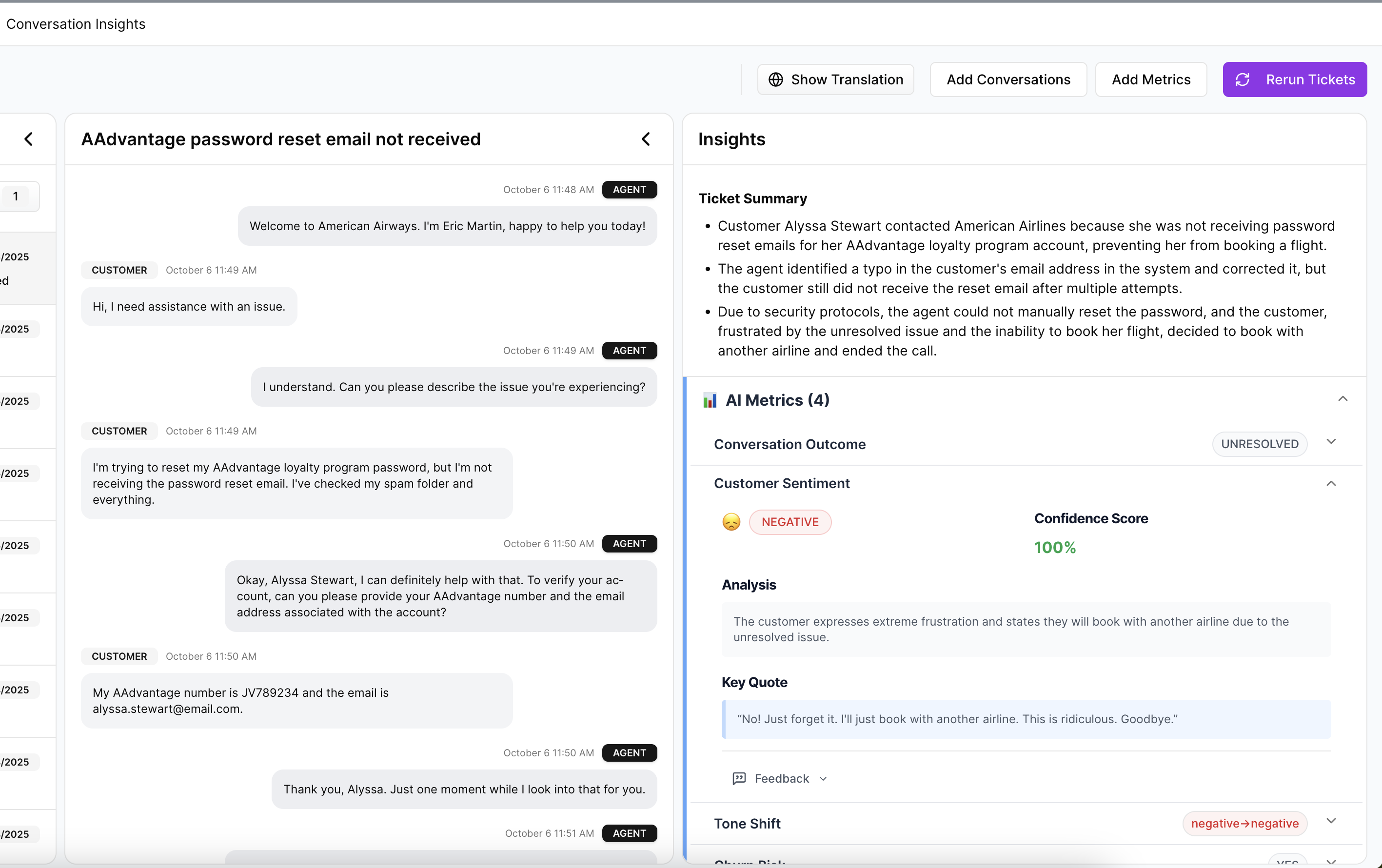
The part that changes the meeting, though, is Evidence-Backed Traceability. Every aggregate number can link back to the source conversations and quotes. So when a product lead asks why onboarding sentiment worsened, you're not waving at a dashboard. You're drilling into the tickets behind the trend.
A faster way to find patterns and validate them
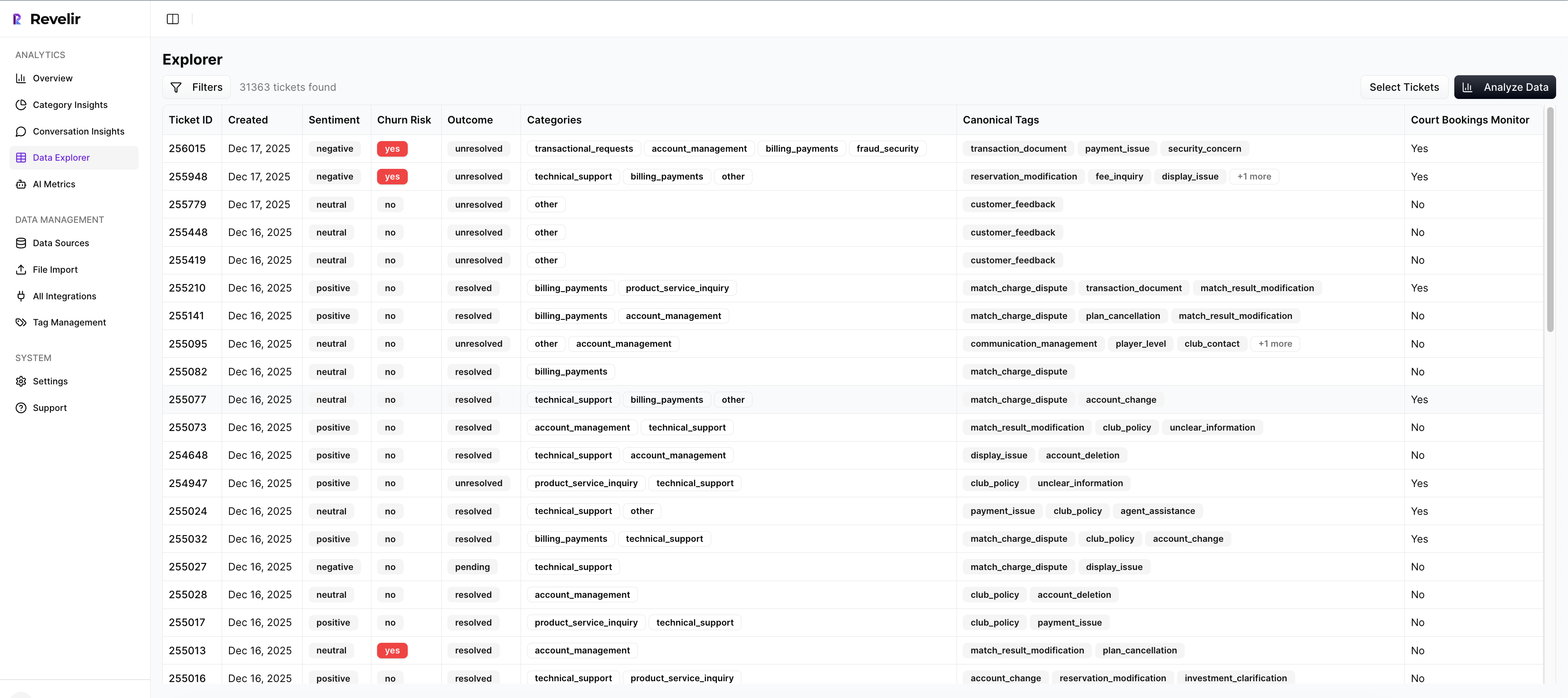
Revelir AI's Data Explorer gives teams a pivot-table-like workspace for row-level analysis across every ticket. You can filter, group, sort, and inspect tickets by sentiment, churn risk, effort, tags, drivers, and custom metrics. Then Analyze Data summarizes those metrics by dimensions like Driver, Canonical Tag, or Raw Tag, with grouped tables and charts that still connect back to the underlying conversations.
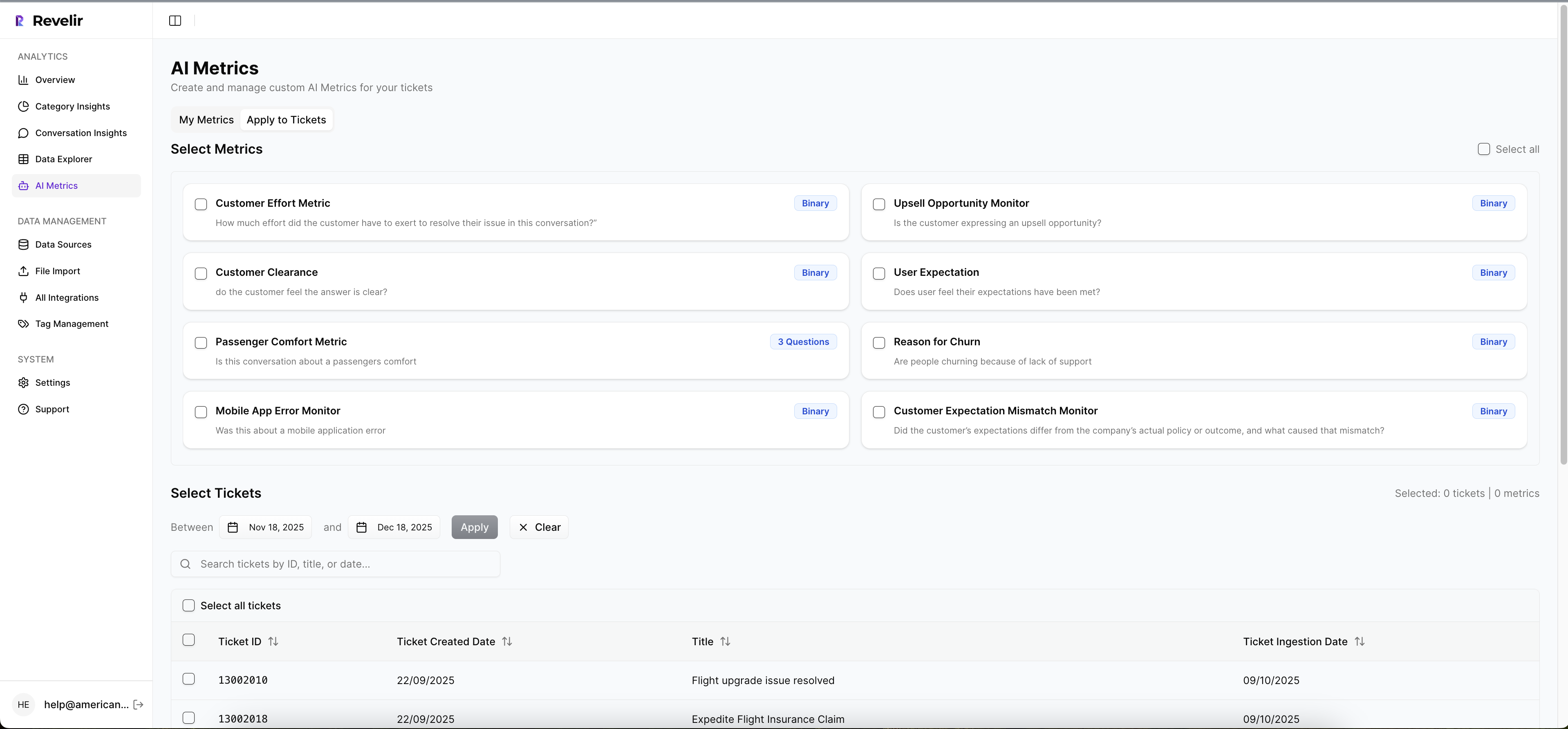
That closes the gap between pattern-finding and proof. Conversation Insights lets you drill into full transcripts, AI-generated summaries, assigned tags, drivers, and metrics for ticket-level validation. And if your business needs a different lens, Custom AI Metrics let you define classifications in your own language, then use them as columns in the same analysis flow.
The practical win is simple. Revelir AI helps you move from score-watching to evidence-backed decisions without forcing a new workflow first. If you want to test that with your own tickets, Get started with Revelir AI (Webflow).
What better customer sentiment decisions look like from here
Understanding customer sentiment through support conversations isn't really about sentiment. It's about whether your team can see the pattern, prove the pattern, and act on the pattern before the issue gets expensive.
If your current setup depends on samples, screenshots, or score-only dashboards, the next step isn't another meeting about reporting. It's building an evidence chain from conversation to metric to decision. Start there. The rest gets a lot clearer, fast.
Frequently Asked Questions
How do I analyze customer sentiment trends over time?
To analyze customer sentiment trends over time, you can use Revelir AI's Data Explorer. Start by filtering your ticket dataset by date range to focus on specific periods. Then, apply the Analyze Data feature to summarize metrics like sentiment and churn risk by dimensions such as drivers or canonical tags. This will help you see how sentiment has changed and identify any patterns. Make sure to drill down into the underlying tickets to validate your findings with real conversations.
What if I want to customize the metrics I track?
If you want to customize the metrics you track, you can use Revelir AI's Custom AI Metrics feature. This allows you to define domain-specific classifiers that align with your business needs. You can create custom questions and value options to capture the insights that matter most to your team. Once defined, these custom metrics will be stored as columns in your analyses, making it easy to filter and report on them alongside standard metrics like sentiment and churn risk.
Can I integrate Revelir AI with my existing helpdesk?
Yes, Revelir AI can integrate directly with your existing helpdesk, such as Zendesk. This integration allows you to automatically ingest support tickets, including all relevant metadata and conversation text. This means you can start analyzing your support data without needing to switch systems or perform manual exports. Just connect Revelir AI to your helpdesk, and it will handle the rest, ensuring you have continuous access to fresh data for analysis.
When should I consider using hybrid tagging for my tickets?
You should consider using hybrid tagging when your current tagging system is inconsistent or manual. Revelir AI's Hybrid Tagging System combines AI-generated raw tags with human-aligned canonical tags, ensuring high discoverability and clarity. This approach is especially useful if you handle a large volume of tickets and want to maintain accurate categorization. By letting the system surface granular themes first and then mapping them to canonical categories, you can improve your reporting and insights.