

Customer sentiment is not a score problem. It's a proof problem.
Customer sentiment usually gets treated like a dashboard issue. It isn't. It's a coverage issue, a trust issue, and a proof issue all at once. Let's pretend you're in a product review and someone says customer sentiment is getting worse. Based on what, exactly? A survey slice, a handful of angry tickets, and one dashboard nobody fully trusts. Same thing with support reviews. If nobody's checking the full conversation set, you're not measuring customer sentiment. You're guessing.
Key Takeaways:
- Customer sentiment gets distorted fast when you rely on samples, surveys, or a few loud tickets.
- Basic sentiment labels tell you mood, but not the driver behind it.
- You need full conversation coverage if you want customer sentiment data you can defend in leadership meetings.
- Traceability matters because every chart should lead back to real tickets and quotes.
- The better approach is simple: analyze all conversations, structure the signals, group the drivers, then validate against source evidence.
Why customer sentiment data breaks long before teams notice
Customer sentiment data usually breaks quietly. The numbers still show up. The charts still update. The meeting still happens. But the method underneath has already started losing context, coverage, and trust. That's why customer sentiment can look precise on paper while being shaky in practice.

Customer sentiment breaks when the measurement method strips out context. Surveys capture a tiny subset. Manual reviews catch nuance but miss scale. Basic sentiment tools flatten messy conversations into a label and call it done.
That's the root problem. Most teams think customer sentiment is hard because customers are emotional or inconsistent. Really, customer sentiment is hard because the system used to measure it was built for convenience, not truth. If you're only reviewing a sample of tickets, or if you're leaning on CSAT and NPS to explain what customers feel, you're operating with partial visibility before the meeting even starts.
Sampling creates false confidence
Sampling sounds reasonable right up until volume climbs. A team handling 1,000 tickets a month can't realistically read enough of them to claim they understand overall customer sentiment. Even a small review set takes hours, and you still end up arguing over whether the sample was representative.
That's where things go wrong. The loudest conversations get remembered. The weirdest escalations get repeated. The quiet patterns, the ones that actually signal churn risk or onboarding friction, get missed. In my experience, that's usually where the expensive stuff hides.
A partial view also changes behavior. Instead of fixing what's happening most often, teams chase whatever got surfaced in the last review. That feels active. It isn't always useful.
Scores strip out the reason behind the feeling
A customer sentiment score can tell you positive, neutral, or negative. Fine. But if negative customer sentiment spikes, what are you supposed to do next? That's the part most dashboards can't answer.
Support and product leaders don't just need to know that sentiment dropped. They need to know why. Was it billing confusion? Account access? Slow performance? A broken onboarding flow? Without drivers, customer sentiment becomes a warning light with no map attached.
The data on unsolicited feedback makes this even more obvious. Support tickets often contain product signals customers never put in surveys at all. That's one reason support data has become more important in CX analysis, as firms like McKinsey have noted in their work on customer feedback and experience improvement customer experience analytics.
Trust disappears when nobody can prove the number
Customer sentiment loses force the moment someone asks for proof and the answer is a stitched-together deck of screenshots and anecdotes. Leadership teams don't act on charts alone. They act on numbers they believe. If the evidence behind customer sentiment is fuzzy, the discussion turns into a debate instead of a decision.
That moment matters. A metric without traceability turns into an argument. A metric tied to exact tickets and quotes turns into action. That's a huge difference.
And yes, it gets emotional fast. If you've ever had to defend a support insight in front of product, ops, and execs at the same time, you know the feeling. You aren't just presenting customer sentiment. You're trying to prove you didn't cherry-pick it.
What customer sentiment is really telling you
Customer sentiment is a signal about experience quality across real conversations, not just a label attached to a response. When measured well, customer sentiment shows how customers feel, what triggered that feeling, and which patterns deserve action first. That's what makes it useful.
Most teams stop too early. They see negative customer sentiment and treat it like an endpoint. It should be the start of the investigation. The better question is: what condition produced that sentiment, and for which segment of customers?
Sentiment without drivers is just noise
Negative sentiment by itself is weak guidance. You know something went wrong, but not where to look. That's why teams with lots of dashboards still struggle to prioritize fixes.
Same thing with basic sentiment tooling. It can classify tone at scale, sure. But if it doesn't connect tone to drivers or themes, the output stays shallow. You get a rising line, a red number, and a room full of opinions.
What actually changes decision quality is linking customer sentiment to the underlying reasons. Billing issues. Onboarding friction. Product bugs. Performance complaints. Once the reason is visible, customer sentiment becomes useful instead of decorative.
The best signal often lives in support, not surveys
Survey data is structured, but it's selective. Only some customers respond. Only some questions get asked. Support conversations are messier, but they contain unsolicited feedback, and that's often the more honest signal for customer sentiment.
Researchers at Qualtrics have made a similar point when discussing experience programs: direct feedback matters, but behavior and conversational context often reveal what scores alone miss customer experience metrics. That's why support data deserves more weight than it usually gets.
Support tickets also show timing. You can see when a customer sentiment shift starts, whether it's isolated to one cohort, and which issues repeat across weeks or months. That kind of pattern is hard to get from score-watching alone.
Full coverage changes the conversation
Once you analyze 100% of support conversations, the whole customer sentiment conversation changes. You stop asking whether the sample was fair. You stop building strategies around a tiny slice of ticket data. You stop treating customer sentiment as a vague reputation number.
Instead, you get something more operational. You can measure customer sentiment across segments, look at changes over time, and compare one driver against another. You can ask whether new users are more frustrated than long-term customers, or whether billing complaints carry more churn risk than technical issues.
That's when customer sentiment starts acting like a management tool, not a report.
The cost of bad customer sentiment measurement adds up fast
Bad customer sentiment measurement costs time, slows prioritization, and creates avoidable conflict between CX and product. The first loss is clarity. The second is speed. The third is trust. Most of these costs don't show up as a line item, which is exactly why they linger.
Most of these costs don't show up as a line item. That's why they get ignored for too long. But they're real.
Teams waste hours proving what they already suspect
When your customer sentiment process depends on manual review, every new question creates more work. Someone has to pull tickets, scan threads, summarize patterns, and build a case. Then someone else asks for examples. Then the whole thing starts again next week.
If you handle 1,000 tickets a month and even review 10% manually at three minutes each, that's about five hours for a partial read. Not a full answer. A partial read. And that's before analysis, alignment, or reporting.
Honestly, that's the part a lot of teams undercount. They measure the review time. They don't measure the rework time caused by weak confidence in the results.
Product teams lose the why behind the spike
A spike in ticket volume tells you pressure is rising. A drop in customer sentiment tells you people are unhappy. Neither tells your product team what to fix first unless the issue is tied to a repeatable driver.
Without that layer, roadmaps drift toward anecdote. One PM reacts to a painful escalation. Another reacts to a loud enterprise account. Support reacts to what feels urgent. Nobody's wrong exactly. But the system is.
That misalignment gets expensive because teams spend weeks debating root cause instead of validating it. The hidden cost isn't just time. It's delay.
Weak evidence makes cross-functional meetings worse
Cross-functional reviews get messy when customer sentiment data can't hold up under pressure. CX says sentiment is down. Product asks for examples. Ops asks how widespread the issue really is. Leadership asks whether it's new or ongoing. Then the room slips from action into argument.
I've seen this happen a lot. Once trust breaks, the conversation becomes political. People start defending their function instead of solving the issue.
That's why evidence matters more than most teams think. You don't just need customer sentiment. You need customer sentiment you can trace back to original conversations, quote by quote, ticket by ticket.
How to measure customer sentiment in a way people will trust
If you want customer sentiment that holds up in a leadership meeting, the process has to be boringly defensible. Analyze every support conversation, structure the signals, group the reasons behind them, and validate the result against original ticket evidence. That's the shift. That's the methodology.
Not everyone agrees on the exact order, and fair enough. Some teams want taxonomy first. Some want metrics first. I'd still argue the winning sequence starts with full coverage, because everything after that depends on having the whole picture.
Start with 100% of conversations
Customer sentiment gets more useful when coverage stops being a question. Pull in the full support dataset so you aren't guessing from a sample or relying on whichever tickets got reviewed that week.
That matters for two reasons. First, you reduce bias. Second, you make it possible to compare segments with confidence. If only part of the data is analyzed, every downstream conclusion stays shaky.
This also changes the politics. You aren't asking people to trust a sample design or a manual review process. You're showing them the full body of evidence.
Turn free text into structured fields
Raw conversations need structure before customer sentiment can be compared, filtered, and acted on. Otherwise, the signal stays trapped in paragraphs, side notes, and one-off screenshots. Structure is what turns support language into something teams can actually use.
A workable setup usually includes:
- Sentiment status
- Risk or urgency signal
- Effort indicator where relevant
- Tags for specific themes
- Higher-level drivers that group those themes
Once those fields exist, you can filter and compare them like any other dataset. Until then, you're still reading stories one by one and hoping a pattern jumps out.
Separate granular themes from reporting language
This is where a lot of teams get stuck. Raw themes are messy. Reporting needs order. You need both.
Granular tags surface emerging issues fast because they reflect the actual language and specifics showing up in conversations. Higher-level categories let you roll those specifics up into something leadership can absorb. Same thing with drivers. They bridge the gap between ticket chaos and strategic action.
Without that separation, one of two things happens. Either the taxonomy gets too messy to report on, or it gets too rigid and starts hiding what customers are actually saying.
Make every finding traceable
A customer sentiment system people trust has receipts. If a chart says billing frustration is driving negative customer sentiment among new accounts, you should be able to click into the underlying tickets and see the evidence.
That traceability does two jobs. It validates the metric, and it gives teams language they can use. Product wants examples. CX wants proof. Leadership wants confidence. Traceable evidence gives all three.
For practical guidance on building trustworthy AI systems, even outside support analytics, the NIST AI Risk Management Framework is worth reviewing because it keeps coming back to validity, transparency, and governance AI Risk Management Framework.
Group the data by the question you actually need answered
Customer sentiment becomes operational when you stop looking at it as one top-line number and start slicing it by useful dimensions. Driver. Tag. Time period. Segment. Account type. Support queue. Whatever maps to how your team works.
Then the questions get sharper:
- Which issues are producing the most negative customer sentiment?
- Which drivers carry the highest churn risk?
- Which segment is feeling the most effort?
- Which problem is growing fastest month over month?
That's where insight starts to earn its place.
Discover how leading teams analyze customer sentiment across every support conversation
Where Revelir AI fits when you want customer sentiment you can defend
Revelir AI fits on top of your existing support data and turns messy conversations into structured, evidence-backed metrics you can inspect, group, and validate. It doesn't ask you to replace your helpdesk. It gives you a way to understand what the conversations already contain and make customer sentiment far more defensible.
Full coverage first, then real analysis
Revelir AI processes 100% of ingested tickets through Full-Coverage Processing, so customer sentiment isn't based on a sample or a few manually reviewed threads. You can bring data in through the Zendesk Integration for ongoing imports or use CSV Ingestion for pilots, historical backfills, or testing. That alone changes the quality of the read.
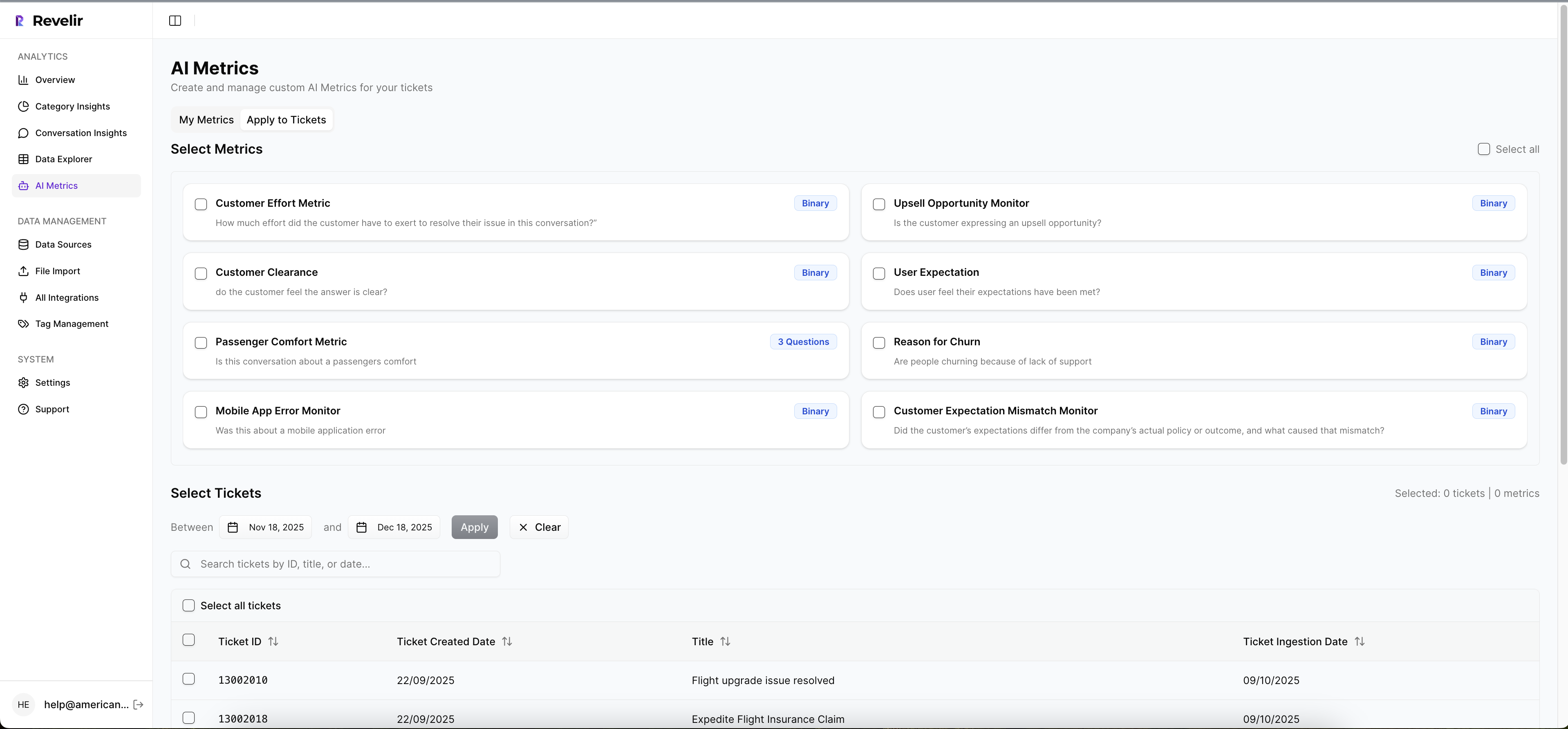
Instead of asking whether the sample missed something important, you can start with the full ticket set and work backward from there. Revelir AI also applies its AI Metrics Engine to compute structured fields like Sentiment, Churn Risk, Customer Effort, and Conversation Outcome. So the raw text becomes analyzable without a manual tagging project up front.
Drivers, tags, and custom metrics make the signal usable
Revelir AI doesn't stop at a customer sentiment label. The Hybrid Tagging System gives you AI-generated Raw Tags for granular patterns and Canonical Tags for reporting language your team can actually use. Drivers then group those issues into higher-level themes like Billing, Onboarding, or Performance, which makes leadership conversations a lot cleaner.
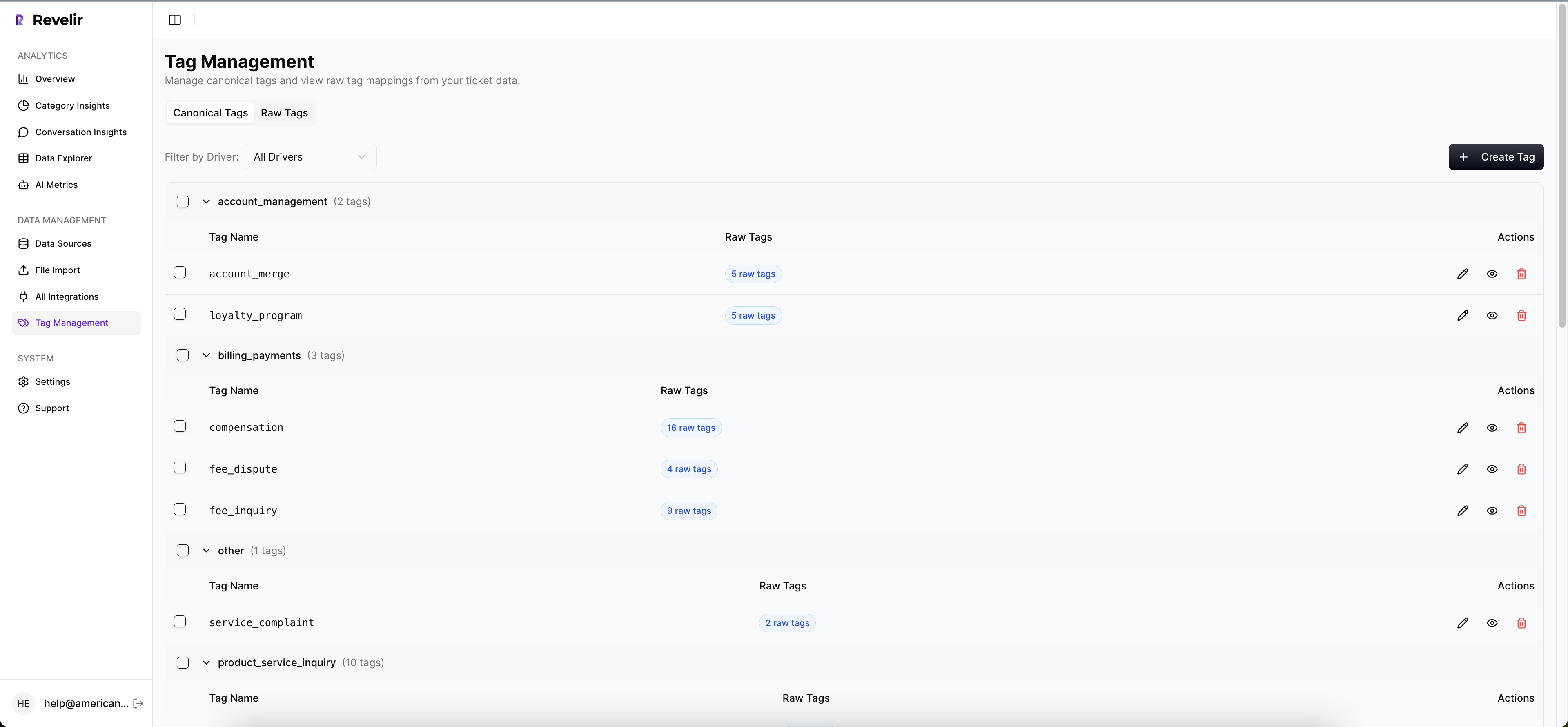
If your business needs something more specific, Custom AI Metrics let you define your own classifiers in your own language. That's important because most teams don't just want to know whether customer sentiment is negative. They want to know whether the conversation signals churn, confusion, upgrade interest, onboarding trouble, or some other business-specific issue.
Start turning support conversations into evidence-backed customer sentiment with Revelir AI
Evidence-backed traceability closes the trust gap
This is the piece most teams have been missing. Revelir AI ties every aggregate number back to source conversations through Evidence-Backed Traceability, and Conversation Insights lets you drill into transcripts, summaries, tags, drivers, and AI metrics at the ticket level.
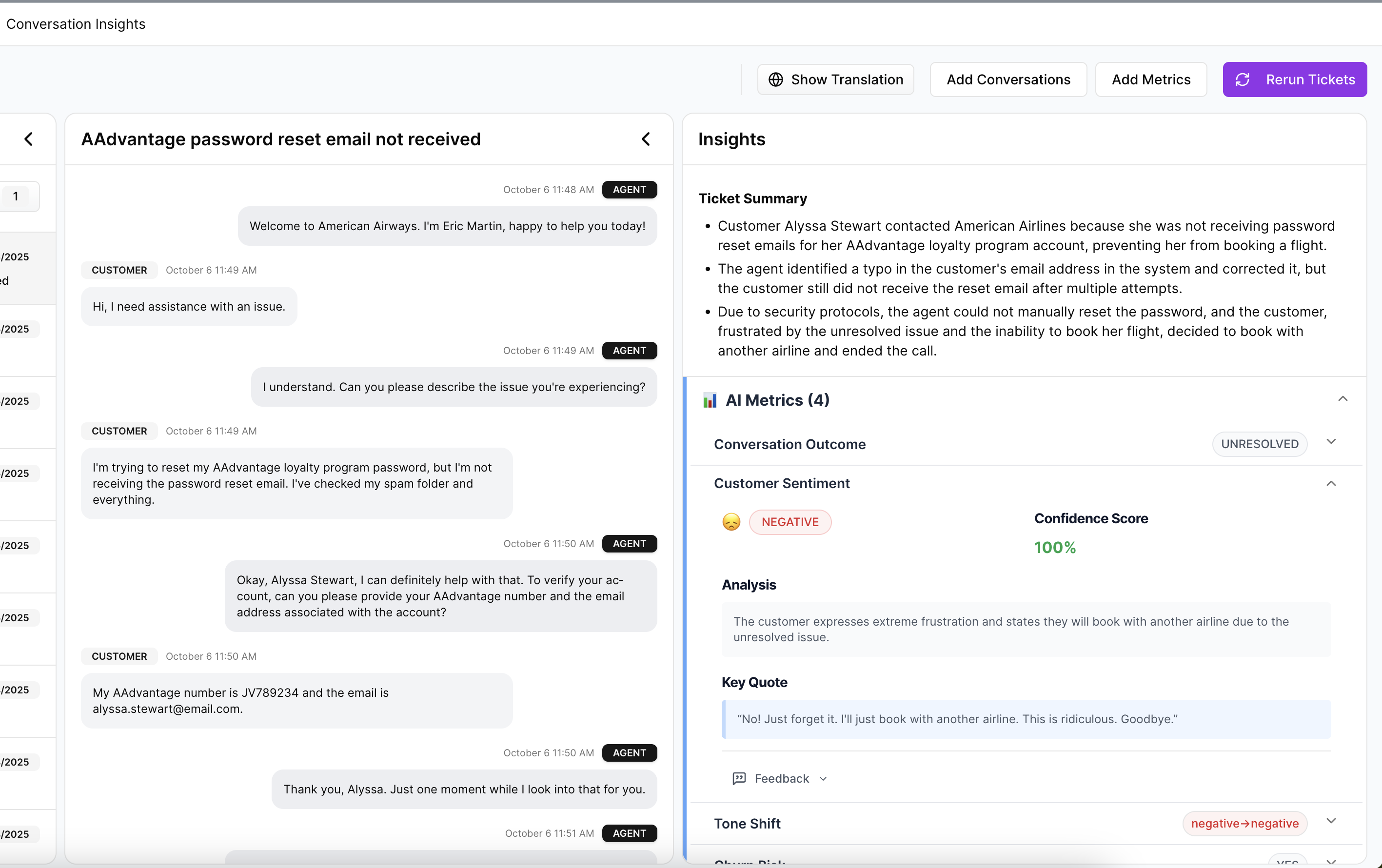
That means when someone challenges the readout, you can validate it. You can inspect the actual conversations behind a chart. You can pull quotes for a product review. You can move from what happened to why it happened without losing trust in the room.
On the analysis side, Data Explorer gives you a pivot-table-like way to filter, sort, group, and inspect every ticket, while Analyze Data summarizes customer sentiment and other metrics by dimensions like Driver, Canonical Tag, or Raw Tag. If you need to move the structured output into an existing BI workflow, API Export handles that part.
Customer sentiment only matters when it changes decisions
Customer sentiment should lead to action, not another dashboard debate. That's the whole point. If the data can't show what changed, why it changed, and where the evidence lives, it won't hold up when priorities are on the line. Good customer sentiment analysis is supposed to reduce debate, not create more of it.
It's usually the same story. Teams have plenty of support data. They just don't have a trustworthy way to turn that data into signals they can act on. Measure the full conversation set. Structure the messy parts. Keep the proof attached. That's when customer sentiment becomes useful.
In other words, customer sentiment only matters if it changes what the team does next. If it helps product prioritize faster, helps CX explain issues more clearly, and helps leadership trust the readout, then great. If not, it's just another number people argue about. Same thing with any metric. Without coverage and proof, it doesn't travel very far.
Frequently Asked Questions
How do I analyze customer sentiment trends over time?
You can track customer sentiment trends by using Revelir AI's Data Explorer feature. Start by filtering your support tickets by date range to focus on specific periods. Then, use the Analyze Data tool to group and summarize metrics like Sentiment and Churn Risk. This will help you visualize changes in sentiment over time and identify any patterns or recurring issues that need attention.
What if I need to focus on specific customer segments?
To analyze customer sentiment by segment, you can utilize the filtering options in Revelir AI's Data Explorer. You can filter tickets based on criteria like account type or support queue. This allows you to see how different segments are experiencing customer sentiment, helping you prioritize which areas to address based on the insights gathered.
Can I customize the metrics I track in Revelir AI?
Yes, you can customize the metrics you track using Revelir AI's Custom AI Metrics feature. This allows you to define specific classifiers relevant to your business needs, such as tracking issues like 'Onboarding Trouble' or 'Churn Risk'. Once set up, these custom metrics will be stored and can be used across your analyses, providing deeper insights tailored to your organization.
When should I use the Evidence-Backed Traceability feature?
You should use the Evidence-Backed Traceability feature whenever you need to validate customer sentiment findings in discussions with stakeholders. This feature links aggregate metrics directly to the source conversations, allowing you to provide concrete examples and quotes when discussing insights. It builds trust and ensures that your conclusions are backed by solid evidence, which is crucial during leadership meetings.
Why does my team struggle with customer sentiment analysis?
Your team might struggle with customer sentiment analysis if they're relying on sampling or basic sentiment tools that don't provide context. To overcome this, consider using Revelir AI's Full-Coverage Processing, which analyzes 100% of support conversations. This approach eliminates blind spots and ensures you have a comprehensive view of customer sentiment, allowing your team to make more informed decisions.