

Top 10 Software for Support Analytics Teams to Evaluate in 2026
Support leaders are now expected to explain queue spikes, customer frustration, and churn signals from the same ticket stream. If you tried to compare the top 10 software for support analytics this week, you probably noticed the market feels crowded, but not cleanly competitive.
That’s because support analytics software is no longer one neat category. It’s usually three different categories wearing the same label: operational monitoring tools, broad voice-of-customer platforms, and support experience systems built around QA, coaching, or automation. If you buy for the label instead of the job, you can end up paying enterprise money for a dashboard that still can’t answer a basic question like, “What’s actually driving customer frustration right now?”
[Table: Software] — See "Table Embed Codes" in Oleno to copy the HTML for this table.
Key Takeaways:
- Best for support ops leaders: qvasa and SupportLogic make sense when queue visibility, alerts, and agent workflows matter more than evidence-backed root-cause analysis.
- Best for CX and VoC teams: Chattermill, SentiSum, and Thematic fit broader feedback programs that combine support with surveys, reviews, and other channels.
- Best for ecommerce automation: Siena is built around containment and response automation, not deep support conversation analytics.
- Best for teams that need ticket-level proof: the strongest fit is the platform that processes 100% of conversations and links every pattern back to underlying tickets.
Top Support Analytics Software Is Splitting Into Three Different Categories
Support analytics software now falls into three buying paths, not one. Some tools watch queues and live operations, some unify customer feedback across channels, and some focus on agent quality or workflow automation. On a top 10 software for support analytics shortlist, qvasa, Chattermill, and SupportLogic may appear side by side, but they solve very different problems.
What these tools are actually built to do
A support operations manager opens Zendesk at 8:15 a.m., sees backlog climbing, and wants to know which queue is about to break. A product leader checks the same support org at 10:00 a.m. and wants to know why onboarding complaints spiked for enterprise accounts. Same raw ticket stream. Completely different job.
That’s the first filter I’d use. Call it the Three-Lens Test. If the buyer’s first question is “what’s happening right now,” they usually need monitoring. If the first question is “what are customers telling us across channels,” they need a VoC platform. If the first question is “which agents, interactions, or workflows need intervention,” they need support experience tooling.
Most buying mistakes happen when teams skip that step. They assume all customer support analytics tools can do all three well. They can’t.
The three buying paths in this market
Operational monitoring tools are built for speed. They focus on live dashboards, queue health, workload, and issue alerts. If you run on Zendesk and need day-to-day control, that category can work well. qvasa fits here.
VoC and customer intelligence platforms are built for breadth. They combine support with surveys, reviews, social, and other feedback sources so teams can spot themes across the whole customer journey. Chattermill and Thematic fit this path. SentiSum sits close to this line too, though with deeper support relevance than some broad VoC tools.
Support experience and QA platforms are built for intervention inside support delivery. They track escalations, quality, coaching, and agent guidance. SupportLogic fits this camp. Siena enters from the automation side rather than analytics-first analysis.
That split matters because implementation cost follows category. If you buy a broad VoC suite when you only needed support conversation analytics, you’ll pay for channel breadth you may never use. The expensive mistake isn’t choosing the wrong logo. It’s choosing the wrong job description.
Why Picking the Wrong Support Analytics Platform Gets Expensive Fast
The wrong support analytics platform gets expensive because the real cost isn’t just license price. It shows up as sampled reviews, weak tagging, slow root-cause analysis, and leadership debates that go nowhere. A polished dashboard can still leave your team guessing which issue to fix first.

Why dashboards alone don't answer root-cause questions
Dashboards summarize. They rarely explain. McKinsey’s 2024 customer care research points to the growing pressure on support teams to use AI in ways that improve both efficiency and customer outcomes (McKinsey). But efficiency without explanation is where a lot of teams get stuck.
Let’s pretend your CSAT dips 9 points in two weeks. The dashboard tells you that happened. Great. Nobody’s checking whether the real driver was billing confusion, failed authentication, shipping delays, or some ugly mix of all three. If the tool can’t move from score to driver to example, the team still ends up doing manual review.
I call this the Score-to-Source Gap. If a platform can’t get you from top-line metric to ticket evidence in under three clicks, it’s probably not giving decision-ready insight. That threshold matters because once it takes longer than that, managers go back to spreadsheets and anecdotal screenshots.
The cost of sampled reviews and incomplete tagging
Zendesk’s customer service statistics keep making the same point in different ways: customer expectations are high, and support teams are under pressure to move fast while still being accurate (Zendesk). Sampling fights that reality. It feels efficient. It often creates blind spots.
Picture a team handling 1,000 tickets a month. They manually review 10%, tag a subset, and build a story from that sample. Three weeks later, churn risk shows up in accounts nobody reviewed because the signal lived in a cluster of “minor” tickets that never made the sample. That’s not a tooling inconvenience. That’s a missed warning.
Fair point, not every team needs 100% analysis on day one. Small teams with 100 tickets a month can survive with lighter processes for a while. But once volume passes roughly 500 to 1,000 monthly tickets, partial review becomes a liability. Bias creeps in. Tags drift. Trends get argued instead of measured.
What to compare before signing a contract
Before signing anything, compare five things. Not twenty. Five.
First, coverage. Does the platform analyze every relevant conversation, or are you still relying on manual tagging or selective review? Second, traceability. Can a chart or metric be tied back to the exact ticket and quote? Third, taxonomy flexibility. Can you use your own business language, or are you boxed into canned themes? Fourth, workflow fit. Is this built for ops monitoring, VoC breadth, or support experience? Fifth, time to value. If setup takes 90 days, you should know that up front.
Some teams prefer broad experience suites because they want one layer across the whole company, and that’s valid. But if support tickets are your richest signal source, support conversation analytics should probably sit at the center of the stack, not as an afterthought hanging off a survey tool. So which tools actually make the top 10 software for support analytics shortlist worth reviewing?
Top 10 Support Analytics Software Tools to Evaluate in 2026
These support analytics tools span monitoring, VoC, support experience, and automation categories. When teams search for the top 10 software for support analytics, the right choice depends less on logo recognition and more on whether they need queue control, broad feedback analysis, or ticket-level evidence. That distinction shapes both cost and usefulness.
Operational monitoring tools
Operational monitoring tools are strongest when leaders need live visibility into queues, backlogs, and issue alerts. They’re weaker when product or CX teams want deep driver analysis across ticket content. qvasa is the clearest example in this group.
1. qvasa
qvasa appears to be a practical fit for teams that live inside Zendesk and want real-time operational monitoring more than deep analytics. Its positioning centers on dashboards, issue reporting, and Zendesk-centric workflows (qvasa). That makes it useful for frontline control, but narrower for teams asking broader root-cause questions.
A support ops lead can get value here fast if the pain is visibility. Queue spikes. Workflow alerts. Operational reporting. Same thing with teams that don’t want a heavyweight analytics rollout and mostly need their Zendesk data presented more clearly.
The limitation is structural. Once your head of CX asks why enterprise customers are getting more negative, or your product lead wants evidence behind billing complaints, operational dashboards alone usually stop short. That’s where monitoring and analysis split.
How Revelir AI is Different: qvasa is strongest when the job is live Zendesk monitoring and issue alerting. Revelir AI is built for full-ticket analysis across support conversations, with AI metrics, raw plus canonical tagging, and drill-down evidence tied to underlying tickets.
VoC and customer intelligence platforms
VoC and customer intelligence platforms are strongest when teams want to combine support data with surveys, reviews, and other customer feedback. They’re often broader than support-only tools, which helps with executive reporting but can add complexity. SentiSum, Chattermill, and Thematic fit here.
2. SentiSum
SentiSum positions itself as AI-native VoC and support analytics, with automated ticket tagging, support intelligence, and multi-source feedback analysis (SentiSum). It’s one of the more support-relevant tools in the broader VoC camp.
What stands out is breadth plus actionability. SentiSum also emphasizes natural-language exploration and support analytics use cases in alternative comparisons and category framing (SentiSum Alternatives). For subscription businesses watching churn, that’s a meaningful angle.
The tradeoff is cost and complexity. Public comparisons and market roundups often place SentiSum in a more premium tier for support analytics buyers (SurveySparrow roundup). That can be reasonable for mature teams. It’s harder to justify if you mainly need deep ticket analytics rather than broad VoC coverage.
How Revelir AI is Different: SentiSum leans into broad VoC analytics, anomaly detection, and conversational querying. Revelir AI is a tighter fit when the priority is evidence-backed traceability, full support conversation coverage, custom AI metrics, and analyst-style exploration through Data Explorer.
3. Chattermill
Chattermill is built for organizations that want one view across many feedback channels, including support, surveys, and reviews. Its product updates and VoC content show a steady push toward broad customer intelligence and enterprise reporting (Chattermill Product Updates).
That breadth is the appeal. A CX team running quarterly readouts across support, NPS, app-store feedback, and survey comments can get a more unified picture than they would from a support-only tool. For large enterprises, that matters.
But support-only teams can end up paying an omnichannel tax. If 80% of your signal lives in tickets, a platform optimized for broad channel aggregation may feel like buying a full command center when you really needed a sharper microscope.
How Revelir AI is Different: Chattermill is broader in channel coverage and enterprise VoC scope. Revelir AI goes deeper on support conversations specifically, with full-coverage processing, direct traceability to quotes, flexible ticket exploration, and custom metrics tied to operational questions.
4. Thematic
Thematic is a research-oriented voice of customer platform with strong emphasis on text analytics, taxonomy control, and thematic analysis (Thematic Text Analytics). It tends to appeal to insights and research teams that care a lot about auditability and category control.
That’s a real strength. Some teams want tighter oversight over how themes are structured and reported. Thematic also publishes heavily around qualitative analysis methods, which tells you a lot about who it’s for (Thematic Qualitative Analysis).
The downside is speed. Research-grade control often means more setup, more taxonomy work, and a slower path from raw support data to operational action. If your team needs fast answers from live ticket streams, that can become friction.
How Revelir AI is Different: Thematic works well for broader VoC and research programs. Revelir AI is narrower by design, using AI-generated raw tags, canonical tags, drivers, and ticket-level evidence to accelerate support insight without requiring heavy manual taxonomy work up front.
Support experience and QA platforms
Support experience platforms are strongest when support leaders want predictive escalations, QA automation, coaching, and agent assistance. They’re often built for larger organizations with mature support operations. SupportLogic sits here, and Siena enters from the automation side rather than analytics-first analysis.
5. SupportLogic
SupportLogic is built around support experience management, with a data layer, predictive support signals, and knowledge-focused AI initiatives (SupportLogic Data Cloud). Its public materials also show a strong interest in knowledge operations and agent workflows (SupportLogic Knowledge Ops).
For large support organizations, that makes sense. If you have 100-plus agents, complex escalations, and QA programs already in place, SupportLogic can fit that operating model. It’s less about lightweight insight discovery and more about enterprise support process control.
The honest limitation is that not every team needs that much machinery. Mid-market groups or cross-functional product and CX teams may find the setup, workflow depth, and enterprise orientation heavier than they want.
How Revelir AI is Different: SupportLogic is oriented toward enterprise-scale support operations, agent coaching, and in-workflow assistance. Revelir AI is built for transparent conversation analysis, ticket-level validation, customizable metrics, and leadership-ready reporting linked back to source evidence.
6. Siena
Siena is primarily known as an ecommerce-focused AI support platform centered on automation, containment, and brand-aligned customer interactions (Siena). Third-party comparisons also frame Siena around ecommerce specialization rather than general support analytics breadth (Yuma vs Siena).
That makes the best-fit buyer pretty obvious. If your main question is “how do we automate more of our support workload without breaking brand tone,” Siena deserves a look. Returns, order issues, and repetitive ecommerce flows are where it makes the most sense.
If your question is “why are certain issues rising, which drivers are affecting enterprise customers, and where’s the proof,” it’s the wrong tool category. Automation-first and analytics-first are not the same purchase.
How Revelir AI is Different: Siena is mainly an automation and AI-agent choice for ecommerce support workflows. Revelir AI is an analytics platform for understanding why issues happen through tags, drivers, AI metrics, and evidence-linked ticket analysis.
How Revelir AI Fits Teams That Need Evidence-Backed Support Insights
Revelir AI fits teams that need proof, not just pattern summaries. It processes support conversations at full coverage, applies custom AI metrics and hybrid tagging, and lets teams drill from aggregate trends into source tickets. For buyers reviewing the top 10 software for support analytics, that makes it especially relevant for product, CX, and support leaders who need defensible decisions from helpdesk data.
Where Revelir AI is structurally different
A lot of tools stop at scores. Revelir AI is built around what I’d call the Evidence Loop: analyze everything, structure the patterns, then validate the pattern against the ticket itself. That changes how decisions get made.
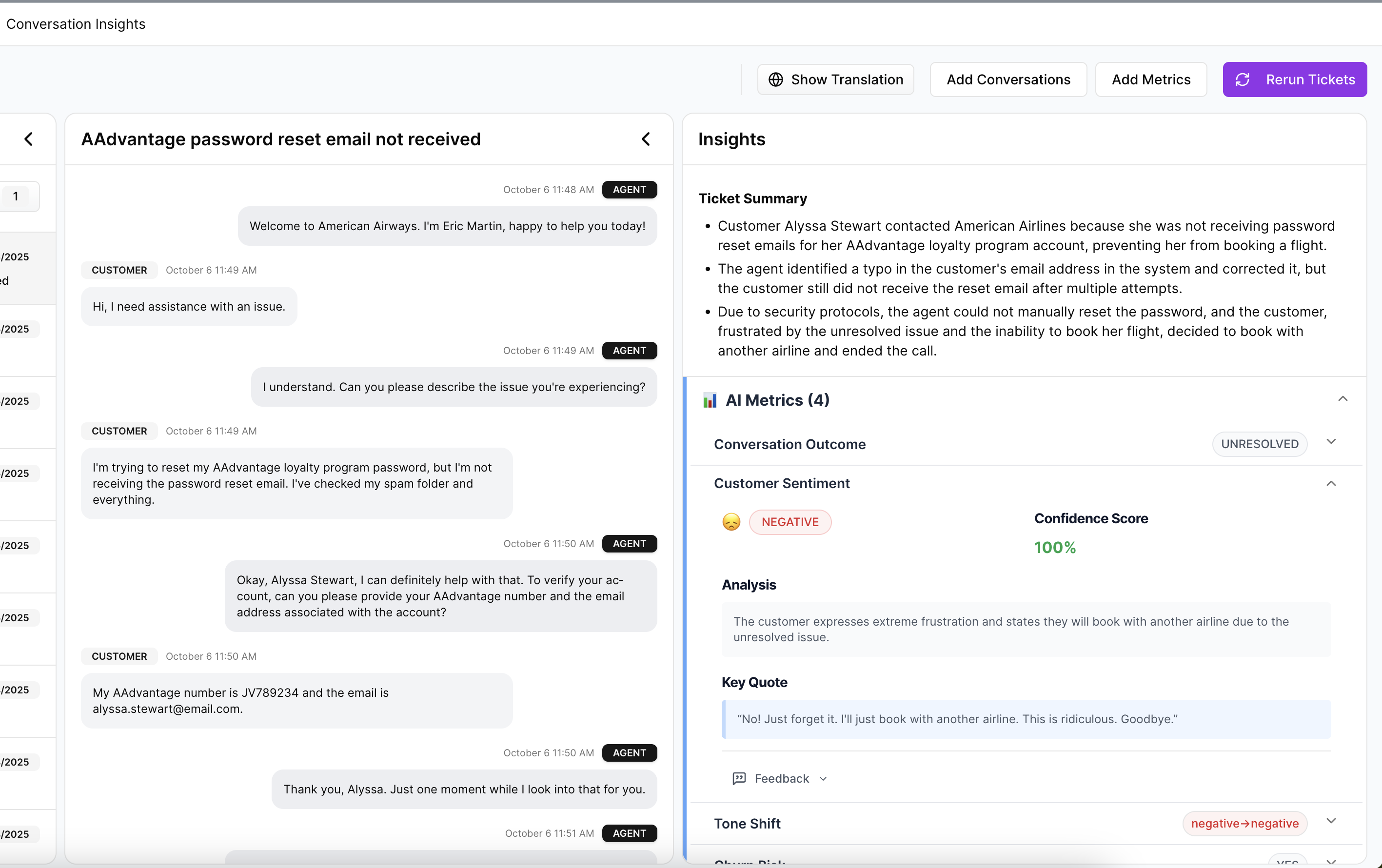
A CX leader can filter negative sentiment, group by category driver, run analysis, and inspect the exact conversations behind the spike. A product team can isolate high-value accounts, layer in churn risk or effort, and see which problems cluster there. If you’re trying to answer “what’s driving negative sentiment right now?” or “which issues are hitting enterprise customers?” that workflow matters because it mirrors how real teams investigate problems.
There’s a tradeoff here too. If your core need is omnichannel VoC across surveys, social, reviews, and app feedback, a broader platform may still be the better fit. But if support conversations are the main source of truth, going deep beats going wide.
Best-fit teams, workflows, and rollout path
Revelir AI makes the most sense for data-driven product, CX, and support teams that don’t trust sampled reviews and need source-backed insight quickly. That buyer usually wants five things: full ticket coverage, traceable insights, custom AI metrics, deep exploration, and fast time to value.
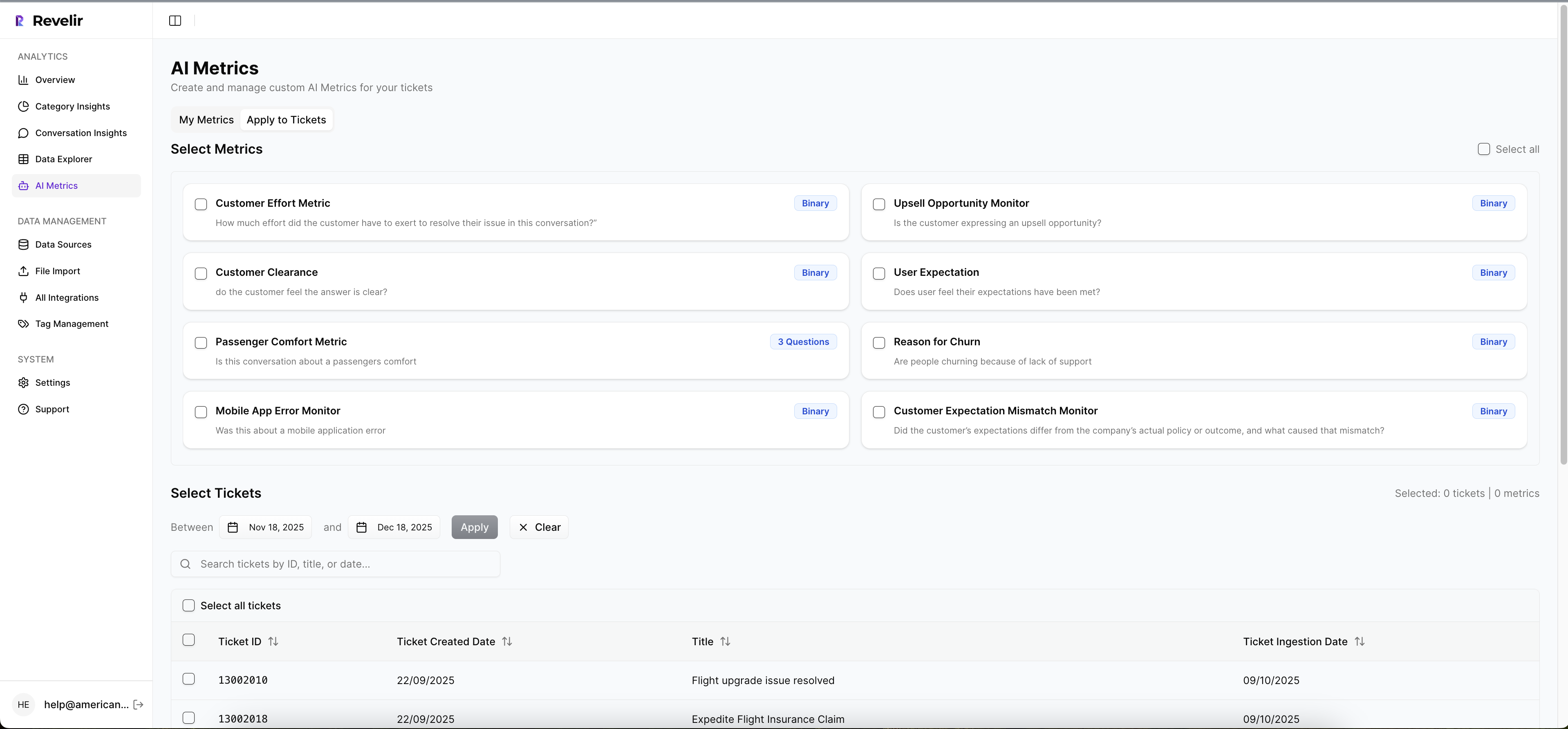
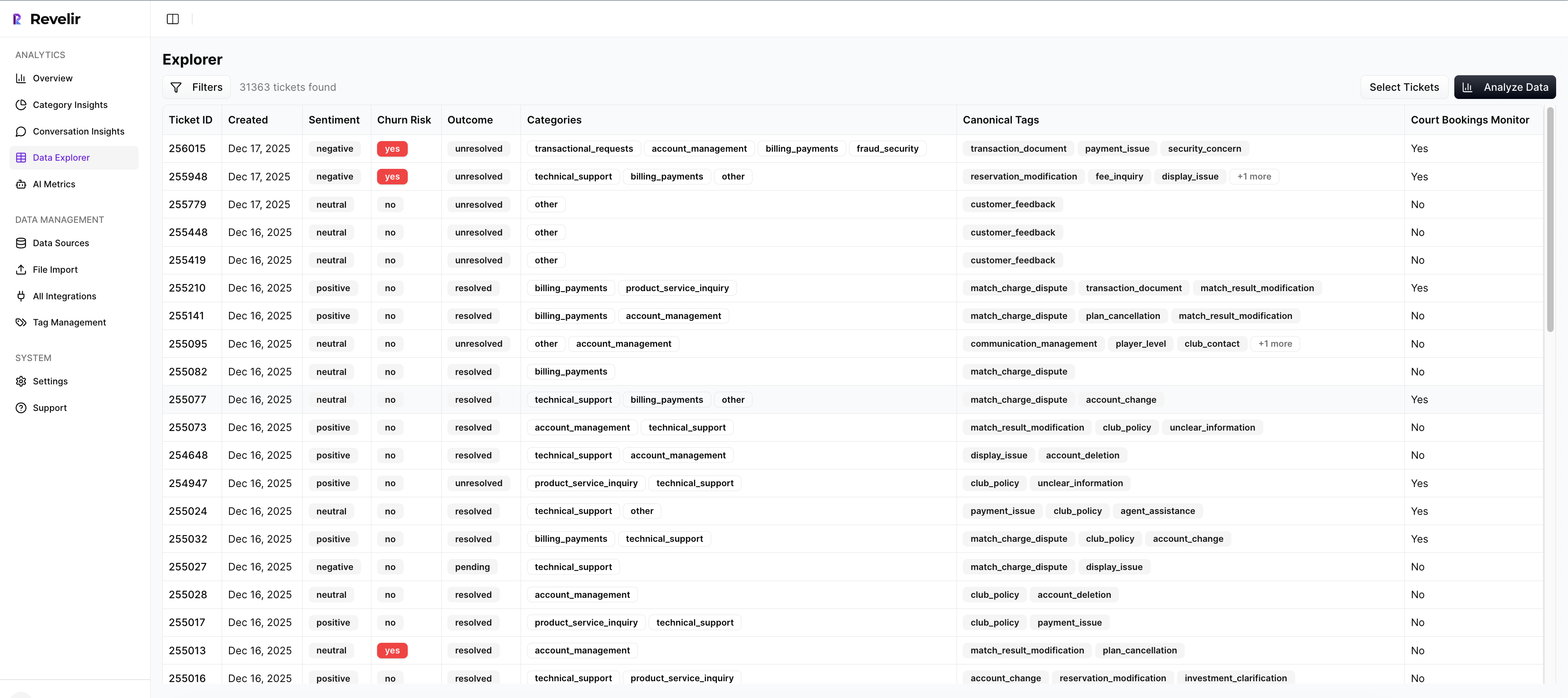
The rollout path is pretty direct. Teams upload past tickets or connect the helpdesk, start analyzing conversations, then use Data Explorer and Analyze Data to move from high-level signal to ticket evidence. Metrics like sentiment, churn risk, effort, frustration signals, and product feedback become queryable across the full dataset. Canonical tags and drivers create structure without forcing a manual taxonomy project first.
That matters in meetings. When someone asks, “Show me where this came from,” the answer isn’t a summary slide. It’s the ticket. To see that workflow in context, Learn More.
Which Type of Support Analytics Software Is the Best Fit
The best support analytics software depends on the operating question your team asks most often. Choose monitoring if you need queue control, VoC if you need broad feedback synthesis, and evidence-backed support analytics if you need root-cause analysis tied to real tickets. In any top 10 software for support analytics comparison, that choice matters more than any feature checklist.
[Table: Software] — See "Table Embed Codes" in Oleno to copy the HTML for this table.
Quick recommendations by team size and use case
If you run a small Zendesk support team and mainly need live queue visibility, start with qvasa. If your company already runs a mature CX program across surveys, reviews, support, and other feedback, Chattermill or Thematic will probably fit better. If you operate a large enterprise support org with coaching, QA, and escalation workflows, SupportLogic deserves serious evaluation.
If you’re an ecommerce brand trying to automate repetitive support flows, Siena is the cleaner choice because that’s what it’s built for. If you’re a subscription business balancing support analytics with wider VoC needs, SentiSum is usually the more natural shortlist entry.
If your team keeps asking for proof, not just trend lines, that’s the dividing line. Revelir AI is the fit for teams that want every metric tied back to the underlying ticket, custom AI metrics in their own business language, and deep exploration across support conversations. That’s a different purchase than buying a dashboard.
The shortcut is simple. Buy for the question you need answered every Monday morning.
Choosing support analytics software isn’t really about picking a winner from a list of logos. It’s about picking the category that matches the decision your team has to make. Monitoring tools help you run the floor. VoC platforms help you synthesize feedback across channels. Evidence-backed support analytics helps you prove what’s happening inside the ticket stream, and why. The smartest shortlist is the one that matches the job before it matches the brand.
Frequently Asked Questions
How do I integrate Revelir AI with Zendesk?
To integrate Revelir AI with Zendesk, start by connecting your Zendesk account in the Revelir AI settings. This allows Revelir to automatically pull in historical and ongoing support tickets, including transcripts and metadata. Once connected, Revelir will continuously process new tickets, ensuring you have up-to-date insights. This integration helps you analyze 100% of your support conversations without manual exports, providing a complete view of customer interactions.
What if I want to analyze historical ticket data?
If you want to analyze historical ticket data, you can upload CSV files containing your past tickets directly into Revelir AI. Go to the Data Management section and select 'File Import' to upload your CSV. Revelir will parse the data and apply its full tagging and metrics pipeline, allowing you to explore insights from your historical support conversations. This feature ensures you can leverage past data for better decision-making.
Can I customize metrics in Revelir AI?
Yes, you can customize metrics in Revelir AI using the Custom AI Metrics feature. This allows you to define specific classifiers relevant to your business needs, such as tracking upsell opportunities or reasons for churn. You can create custom questions and value options, and the results will be stored as columns in your dataset. This flexibility helps tailor the analysis to your unique operational questions.
When should I use the Data Explorer feature?
You should use the Data Explorer feature when you need to dive deep into your support ticket data. It allows you to filter, group, and inspect every ticket with key metrics like sentiment, churn risk, and effort. This feature is especially useful when you're trying to answer specific questions about customer issues or trends, as it links directly to the underlying conversations for validation. It’s a powerful tool for gaining actionable insights from your data.
Why does Revelir AI emphasize full-coverage processing?
Revelir AI emphasizes full-coverage processing to eliminate blind spots and biases that come from sampling. By analyzing 100% of ingested tickets, it ensures that you capture all relevant signals, including subtle patterns that might be missed in a sampled approach. This comprehensive analysis provides more accurate insights, enabling teams to make informed decisions based on complete data rather than a limited view.