

Sampling 10% of tickets gives you 10% of the truth. If you're making product or CX calls from that, you're not running an insight system. You're running a confidence theater.
The importance of hybrid tagging shows up the minute you try to explain a pattern to someone senior. Raw AI labels alone get messy fast. Manual categories alone miss the weird new stuff hiding in live support traffic.
Key Takeaways:
- Hybrid tagging matters because raw tags catch nuance while canonical tags make reporting usable
- If you only use manual tags, you miss emerging issues before they become expensive
- If you only use AI-generated tags, you get discovery without enough clarity for leadership decisions
- The practical threshold is simple: if more than 15% of your ticket themes don't fit your current taxonomy, your tag system is already drifting
- Evidence-backed traceability is what turns tags from opinion into something teams can defend
- Full coverage beats sampling when you need to prioritize what to fix first, not just describe what happened
- Support analytics gets more useful when you can move from "what's going on?" to "show me the exact tickets behind it"
If you want the short version, Learn More. The rest of this article is the longer version, and honestly, that's where the real value is.
Why Support Teams Get Tagging Wrong
Hybrid tagging is important because support data breaks the second you force a messy conversation into one rigid label. Tickets don't arrive neat. They arrive with overlap, ambiguity, weird phrasing, and edge cases that nobody planned for.

A support leader usually sees this around month two of trying to clean things up. Someone exports Zendesk, opens a spreadsheet, filters 500 tickets, and starts tagging by hand. By Friday, "billing issue," "invoice confusion," "refund question," and "charge dispute" all mean slightly different things to different people. Then product asks for a trend report. Now everyone's arguing about categories instead of the actual customer problem. It's exhausting, and worse, it's expensive.
The old assumption is that tagging fails because teams aren't disciplined enough. I don't buy that. The real issue is structural. Human-made taxonomies are too slow to capture what's emerging in real time, while pure AI labels create too much granularity for reporting. Same thing with sentiment dashboards. They look clean right up until somebody asks, "What exactly is driving the drop?"
Manual tags feel safe, but they age badly
Manual tagging has one real advantage: people trust labels they created. Fair enough. If a CX lead names a category "Onboarding Friction," that phrase will make sense in a product review.
But manual systems decay fast. New products launch. Policies change. One bug creates five new complaint patterns in a week. Your taxonomy doesn't update itself, and nobody's checking every ticket at scale. That's why I use a simple Drift Rule: if your team creates new label variants in more than 1 out of 8 review sessions, your taxonomy is stale. Not theoretically. Operationally.
The hidden cost is decision lag. You don't just lose consistency. You lose speed. By the time a new issue gets named, grouped, and reported, the problem has already spread.
Pure AI tags find more, but leadership can't use chaos
AI-generated tags solve the coverage problem. They surface patterns people miss. That's the upside, and it's a big one.
The downside is that discovery alone isn't enough. If your dataset fills up with hundreds of fine-grained labels, you get insight fragments, not a reporting system. One model might surface "billing_fee_confusion," "unexpected_renewal_charge," and "refund_request_followup" as distinct signals. Useful? Yes. Ready for an exec readout? Not by themselves. You still need a layer that rolls those into language your business uses.
Let's pretend you're in a monthly review with product, support, and ops. You say negative sentiment is up in billing. Good start. Then somebody asks which billing issue, for which segment, and whether it connects to churn risk. If all you've got is a pile of raw labels or a few sampled anecdotes, the conversation stalls. That's the moment weak tagging systems get exposed.
The problem isn't tagging. It's translation.
The importance of hybrid tagging is really the importance of translation. You need one layer that discovers what customers are actually saying and another that organizes it into categories people can act on.
I call this the Discovery-to-Decision gap. Raw tags are discovery. Canonical tags are decision. If you skip the first, you miss what's new. If you skip the second, you can't turn patterns into priorities. The teams that move fastest don't choose one. They connect both.
That raises the obvious question: if hybrid tagging is the right model, what does it actually fix day to day?
What Hybrid Tagging Actually Changes
Hybrid tagging combines AI-generated raw tags with human-aligned canonical categories so teams can spot emerging issues without losing reporting clarity. That's the practical importance of hybrid tagging. It lets you keep nuance and still summarize the signal in a way the business can use.
This is where a lot of people overcomplicate it. They treat tagging like a data hygiene project. It's not. It's a decision system. If the output doesn't help you explain what broke, who it affected, and what to fix first, the structure is wrong.
Start with raw discovery, not forced certainty
A raw tag layer works because support conversations are messy by default. Customers rarely describe the same issue the same way. One says "charged twice." Another says "billing is wrong again." Another asks for a refund after a renewal they didn't expect. The surface language changes. The underlying issue might not.
Raw tags catch that mess before a human prematurely flattens it. That matters a lot in fast-moving environments where new product issues or policy confusion can emerge inside a week. In my experience, this is where most teams go wrong. They standardize too early. They want clean charts before they've understood the data.
Use the 72-Hour Emergence Rule. If a pattern can materially affect retention, effort, or escalations, you need to see it within 72 hours of showing up in ticket volume. Manual-only tagging won't get you there. Hybrid tagging can.
Canonical tags make the signal usable
Canonical tags exist so the organization can actually talk about what it's seeing. They normalize the chaos without erasing it.
That distinction matters. You don't want to delete specificity. You want to roll it up. "refund_request," "late_refund_followup," and "billing_fee_confusion" may all map into broader reporting categories, but you still want the granular layer available when you need to validate the pattern. That's why the importance of hybrid tagging isn't just better organization. It's better escalation logic. Broad category first, drill-down second.
A good test is the Leadership Translation Test. Can a head of support explain the category in one sentence, and can an analyst still trace it back to the original ticket language? If the answer to either side is no, the taxonomy isn't doing its job.
Drivers answer the question scores can't
Scores tell you intensity. Drivers tell you cause. That's a very different thing.
A decline in sentiment is useful. A churn risk flag is useful. High effort is useful. But none of those tells you why the experience is breaking. Drivers do. They group issues into themes like billing, onboarding, account access, or performance so teams can connect operational pain to product or policy choices.
Some people will argue that clean scorecards are enough for executive review, and I get the appeal. They're simple. They're compact. They travel well in slides. But that simplicity is also the problem. If a score goes down and nobody can explain the driver behind it, you've created a dashboard for observation, not action.
Custom metrics make the system match your business
This part gets overlooked. A generic tag system can only take you so far because your business doesn't talk in generic language.
Maybe you care about "Reason for Churn." Maybe you need to spot "Upsell Opportunity." Maybe your team tracks a support issue that's unique to your workflow or product design. If you can't define those as structured signals, you'll end up back in spreadsheet land, stitching together notes from scattered reviews.
That's why I think the importance of hybrid tagging goes beyond tags themselves. It's really about building a structured layer that speaks your company's language without giving up coverage.
If that sounds good in theory, the next question is usually more blunt: how do you tell whether your current system is broken?
How to Tell When Your Tagging System Is Failing
A failing tagging system leaves visible operational fingerprints long before anyone says the words "taxonomy problem." You can usually spot it in reporting friction, repeat debates, and slow prioritization. The importance of hybrid tagging becomes obvious once those failure patterns pile up.
You don't need a full audit to diagnose this. You need a few sharp questions.
Run the 5-question tagging stress test
Ask these five questions:
- Can you explain a trend without manually reading tickets again?
- Can product see which issue clusters drive sentiment or effort changes?
- Can leadership trace a chart back to exact conversations and quotes?
- Can new ticket themes appear without breaking your reporting structure?
- Can you analyze all tickets, not just a sample?
If you answer "no" to two or more, your current system is fragile. If you answer "no" to four or more, stop adding dashboard layers. Fix the tagging model first.
What I like about this test is that it cuts through tool bias. You can have a lot of charts and still have weak insight quality. Happens all the time.
Watch for duplicate categories and argument loops
One early red flag is duplicate-category sprawl. That's when teams keep inventing slightly different labels for the same issue because the system doesn't support both nuance and standardization.
You see it in meetings. One person says "refund confusion." Another says "billing dispute." Someone else pulls a report on "payment complaints." Now the group spends 20 minutes reconciling terms. Nobody is lying. The model is just too loose to support consistent reporting.
I use a simple benchmark here. If your top 10 issue categories require more than 10 minutes of explanation in a leadership review, the taxonomy is too noisy. Clean reporting should compress complexity, not recreate it.
Sampled reviews create false certainty
Sampling feels responsible because it looks like analysis. You review 50 or 100 tickets, note patterns, maybe pull a few quotes. But the issue isn't effort. It's representativeness.
A sampled review misses quiet patterns. It overweights memorable stories. It turns every insight into a debate about whether the sample was "good enough." That's why the importance of hybrid tagging and full coverage are connected. One gives you structure. The other gives you confidence that the structure reflects reality.
We've seen this logic play out across analytics more broadly too. McKinsey has written about the value of turning unstructured data into decision inputs teams can actually use, not just observe in theory, in its work on advanced analytics and AI adoption for business operations here. Different domain, same basic lesson.
Traceability is the trust threshold
This one matters more than most teams realize. Insight without traceability doesn't travel well across functions.
Support may trust an internal pattern because they live in the tickets. Product won't always. Finance definitely won't. Senior leadership wants to know where the number came from, whether it represents a real shift, and what customers actually said. That's reasonable. In fact, it's healthy.
So here's the rule: if a metric can't be traced to the underlying tickets and quotes in under three clicks, it won't survive a hard prioritization meeting. That's the Traceability Threshold. And yes, it sounds strict. It should.
Once you accept that your old setup is breaking, the fix isn't more tagging labor. It's a better operating model.
A Better Model for Support Intelligence
The better model is simple: analyze 100% of conversations, let AI surface granular patterns, map them into human-readable categories, and keep every result tied to source evidence. That's the importance of hybrid tagging in context. It's not a tagging trick. It's the backbone of a support intelligence system.
What's changed over the last few years is that teams can finally do this without rebuilding their whole support stack. You don't need a new helpdesk. You need a layer that sits on top of the tickets you already have and turns free text into something measurable.
Use the 100-100-100 framework
I think about this as the 100-100-100 framework:
- 100% coverage so you're not guessing from samples
- 100% traceability so every metric can be defended
- 100% usability so the insight works for support, product, and leadership
Miss one of those and the system weakens. Full coverage without traceability creates black-box anxiety. Traceability without usability creates analyst-only insight. Usability without coverage gives you polished guesses.
This is also where a lot of black-box AI tools lose people. They produce labels, maybe even decent ones, but nobody can inspect the reasoning through the original conversations. Trust drops fast.
Build around decisions, not reports
Reports are outputs. Decisions are the point. That's a small wording shift, but it changes how you design the whole system.
A decision-first model asks different questions. Which driver is pushing negative sentiment among enterprise customers this month? Which issue has high customer effort and rising churn risk? Which pattern is new versus recurring? Those are ranking questions, not vanity-dashboard questions.
For support organizations trying to work better with product, that's a huge difference. The conversation stops being "ticket volume increased" and becomes "account access issues drove the highest negative sentiment among high-value customers, and here are the exact transcripts." Much harder to ignore.
Keep the raw layer and the reporting layer connected
This is the non-negotiable part. Don't choose between discoverability and clarity. Keep them connected.
Hybrid tagging works because raw tags and canonical tags serve different jobs. Raw tags help you detect what customers are saying in the wild. Canonical tags help you explain that signal consistently over time. Drivers then add the high-level "why" layer that makes the readout useful in planning.
If you break that chain, bad things happen fast. Discovery without roll-up creates clutter. Roll-up without discovery creates blind spots. Driver summaries without source evidence create skepticism. It all sounds manageable until you're in a room trying to defend why one issue should outrank another.
For teams that want to get past that, Get started with Revelir AI (Webflow) is the natural next step.
How Revelir AI Makes Hybrid Tagging Usable
Revelir AI turns the importance of hybrid tagging into an actual working system by processing support conversations, structuring them into metrics and tags, and keeping every result tied back to the original tickets. That's the difference between a concept and a tool you can use on Monday.
The product doesn't ask you to replace your helpdesk. It sits on top of your support data through Zendesk Integration or CSV Ingestion, then processes 100% of those conversations through its tagging and metrics pipeline. That matters because sampled analysis is where most teams lose the plot in the first place.
Evidence you can defend in the room
Revelir AI uses a Hybrid Tagging System with AI-generated Raw Tags and human-aligned Canonical Tags. So you can surface emerging issues at a granular level, then map them into categories your business can report on consistently.
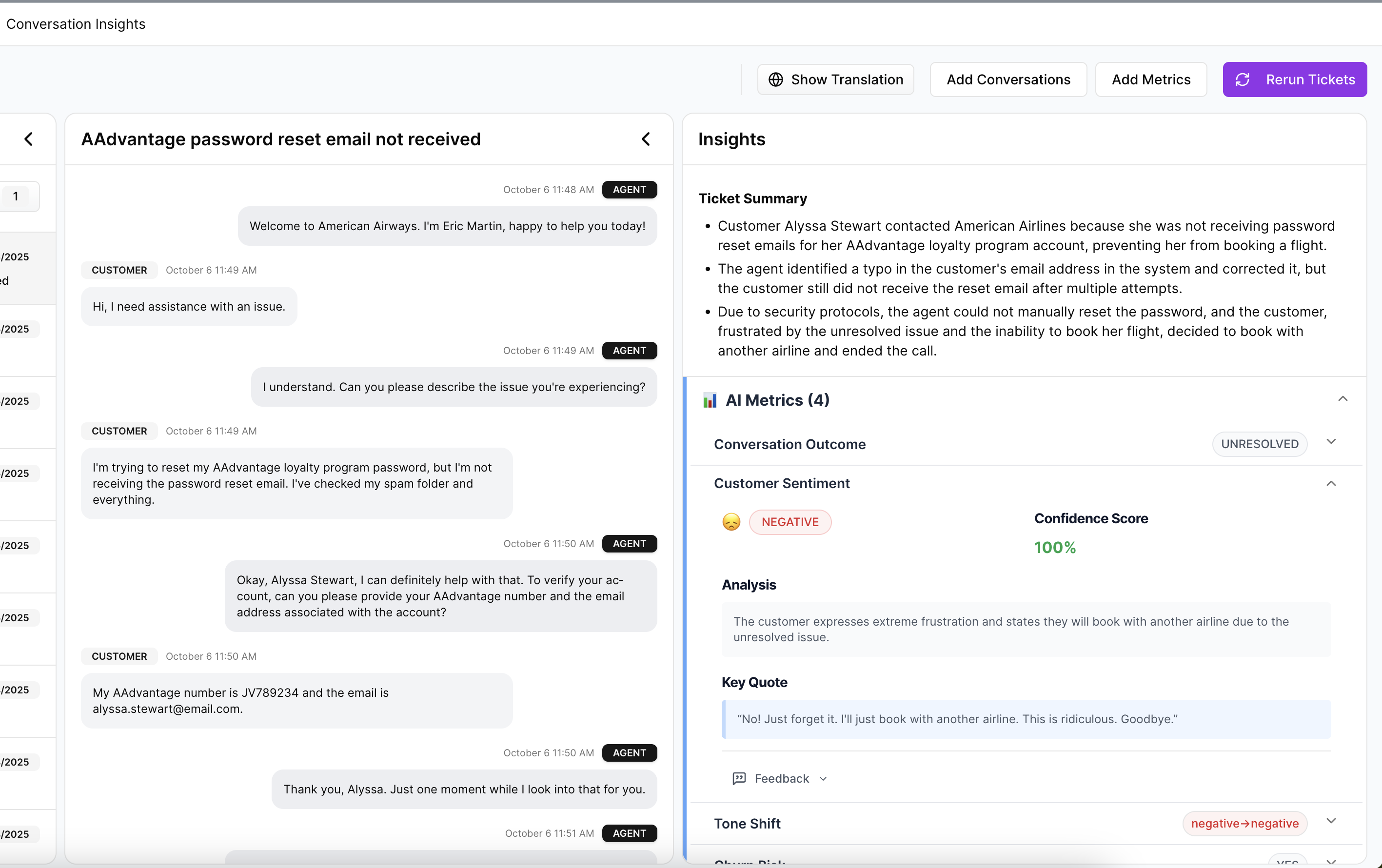
That alone would be useful. But the bigger point is Evidence-Backed Traceability. Every aggregate number links back to the source conversations and quotes. If your monthly review gets challenged, you don't need to hand-wave or promise a follow-up. You can drill into the exact ticket trail behind the metric.
Conversation Insights supports that workflow too. You can inspect full transcripts, summaries, assigned tags, drivers, and AI metrics at the ticket level. That's how the insight holds up under pressure.
A faster way to move from signal to priority
Revelir AI also gives teams a pivot-table-like Data Explorer. You can filter, group, sort, and inspect tickets with columns for sentiment, churn risk, effort, tags, drivers, and custom metrics. For ad hoc work, that matters a lot. Nobody wants to wait on a custom export just to answer a basic question from leadership.
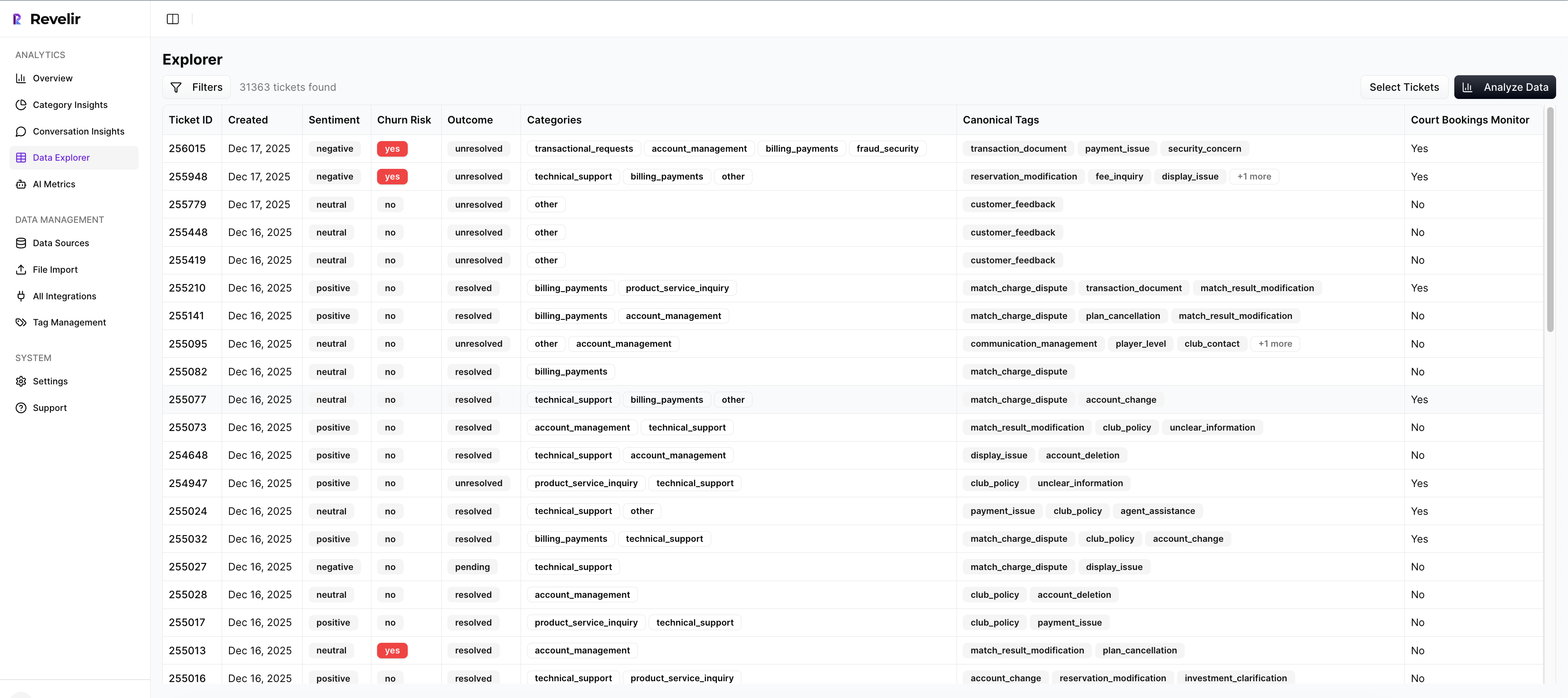
Analyze Data adds another layer by summarizing metrics across dimensions like Driver, Canonical Tag, or Raw Tag, with interactive tables and charts that connect back to the underlying tickets. That's a cleaner path from "we think billing is a problem" to "billing fee confusion is driving negative sentiment and high effort for this segment."
And because Revelir AI supports Custom AI Metrics, teams aren't boxed into generic labels. If your business needs to classify something specific, you can define it in your own language and use it across analysis.
Full coverage changes the quality of the conversation
This is probably the biggest shift. Revelir AI processes 100% of ingested tickets. No manual tagging required upfront. No sampled reviews pretending to be representative.
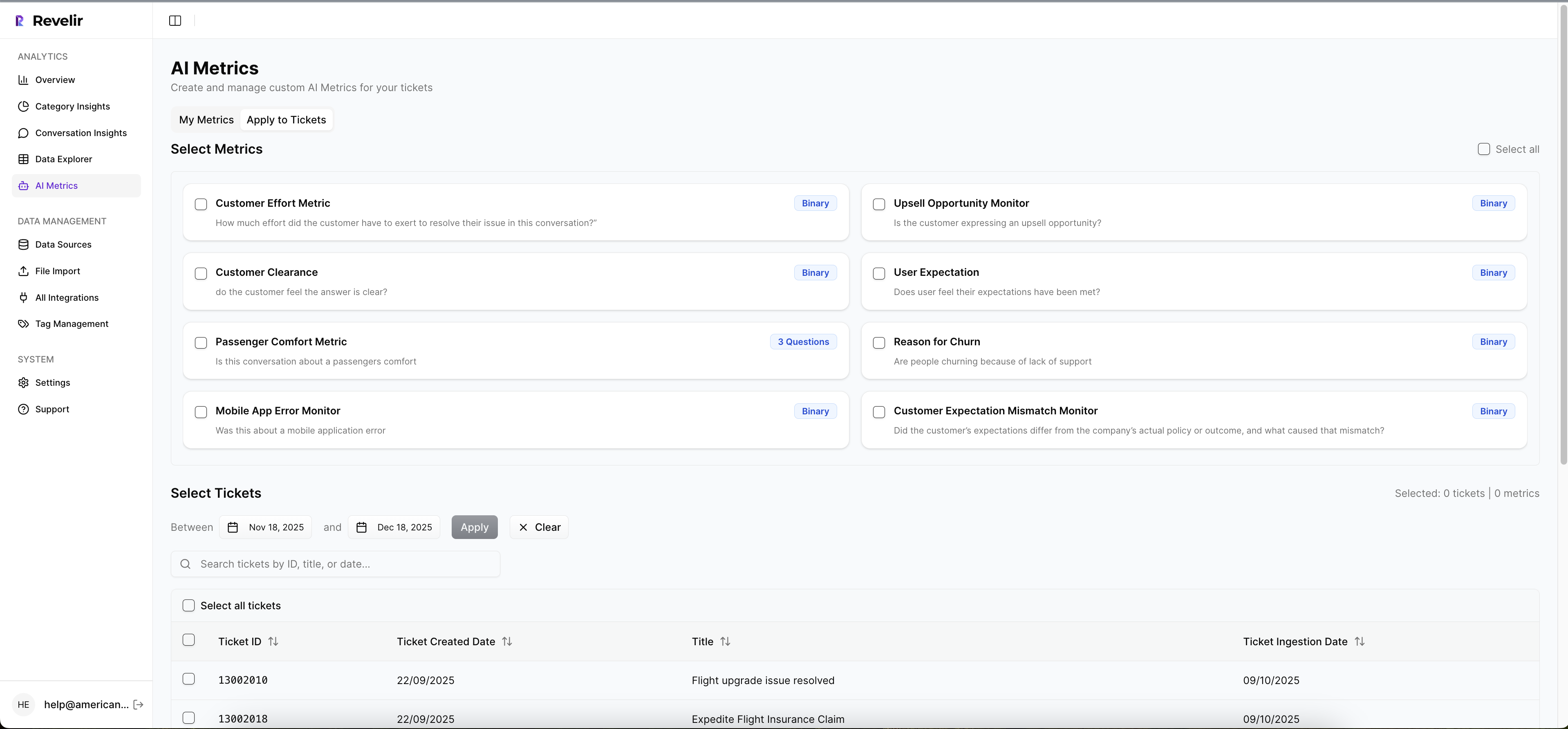
That changes the conversation from debate to prioritization. Instead of arguing about whether a subset was large enough, teams can focus on which issue matters most, who it's affecting, and what should happen next. For CX and product leaders, that's the whole point.
What to do next with hybrid tagging
The importance of hybrid tagging isn't academic. It's operational. If your support insight stack can't discover new themes, normalize them for reporting, and trace every claim back to real conversations, you don't have a reliable decision system yet.
Start there. Audit your current tags. Count duplicate categories. Check how long it takes to prove a chart with ticket evidence. Then ask the hard question: are you seeing the truth, or just the sample that happened to get reviewed?
Frequently Asked Questions
How do I set up hybrid tagging in Revelir AI?
To set up hybrid tagging in Revelir AI, start by integrating your support platform, like Zendesk, to import all historical and ongoing tickets. Once connected, Revelir will automatically generate AI-based raw tags for each conversation. You can then create canonical tags that align with your organization's language, merging similar raw tags into broader categories. This hybrid system allows you to capture emerging issues while ensuring clarity in reporting.
What if my tagging system is too complex?
If your tagging system feels too complex, consider simplifying it by running the 5-question tagging stress test. Ask if you can explain trends without reading tickets manually, if leadership can trace charts back to exact conversations, and if new ticket themes can appear without breaking your reporting structure. If you answer 'no' to multiple questions, it may be time to refine your tagging model using Revelir AI's Hybrid Tagging System, which combines raw and canonical tags for better clarity.
Can I analyze specific themes in my support tickets?
Yes, you can analyze specific themes in your support tickets using Revelir AI's Data Explorer. This tool allows you to filter and group tickets based on various metrics like sentiment, churn risk, and effort. You can also drill down into individual tickets to see the underlying conversations. This way, you can identify patterns related to specific issues, such as billing confusion or onboarding friction, and prioritize them effectively.
When should I consider custom AI metrics?
Consider using custom AI metrics when your business has specific needs that generic tags can't address. For example, if you want to track unique issues like 'Upsell Opportunity' or 'Reason for Churn', you can define these as custom metrics in Revelir AI. This flexibility allows you to tailor the tagging system to your organization's unique language and requirements, making your insights more relevant and actionable.
Why does my team struggle to find actionable insights?
Your team may struggle to find actionable insights due to a lack of full coverage in ticket analysis. Relying on sampled reviews can lead to missing critical patterns. By using Revelir AI, which processes 100% of your support conversations, you can eliminate sampling bias and ensure that every conversation is analyzed. This comprehensive approach helps surface the insights needed to drive product improvements and enhance customer experience.