

Customers do not churn “in aggregate.” They leave after a handful of moments that felt hard, unfair, or ignored. The impact of customer support on churn rates is bigger than most leaders think because support sits at the point of pain, often at the moment of decision. Fix those moments, churn drops. It’s usually that simple in practice.
Let’s pretend your product team ships two small regressions in a month. Nothing catastrophic. Tickets rise a bit. If your dashboard shows volume and CSAT only, you’ll miss who is affected and why. Same thing with sentiment tiles that say “negative trending.” Nice chart. No driver. Nobody’s checking the transcript to see the exact friction that pushed a customer to cancel.
Key Takeaways:
- Link churn to specific support drivers, not scores. Drivers tell you why customers leave, so you can fix the cause.
- Measure 100% of conversations or you’ll miss patterns. Sampling invites bias, delay, and costly mistakes.
- Make every metric traceable to the ticket. Evidence wins budget and unblocks product fixes faster.
- Replace manual tagging with hybrid AI + human canonical tags. You get coverage without losing clarity.
- Standardize custom AI metrics in your language. “Churn mention” or “billing confusion” beats generic sentiment.
- Prioritize by segment and impact, not anecdotes. High-value cohorts with high effort and driver X go first.
- Start with a 30-day baseline, then re-measure after each fix. Prove the churn reduction with evidence.
The Impact of Customer Support on Churn Rates Is Bigger Than You Think
Support touches customers at their highest-stress moments, so it has an outsized effect on churn rates compared to most touchpoints. The contact may be brief, but the memory is sticky, especially if resolution feels slow or unclear. One broken flow in billing or onboarding can turn a one-ticket problem into a lost account.
Support Moments Decide Retention
Churn often comes from a few repeatable moments, not abstract “dissatisfaction.” Think password resets that fail twice, refund confusion, or a silent escalation. You do not need a massive failure to lose a customer, you need one bad moment at the wrong time. In my experience, these moments cluster around onboarding, billing changes, and outages. Remove friction there, churn falls.
When we map churn back to support, patterns emerge quickly. New users stumble on step two. Long-tenured accounts hit a billing edge case. Mobile users face a device-specific bug. Without clear tagging and metrics tied to tickets, these look like unrelated blips. With evidence, they point to one fix with real retention impact.
Scores Don’t Explain “Why”
Scores show a trend, not a cause. A dip in CSAT tells you something is wrong; it doesn’t say why or for whom. Same thing with basic sentiment. It says “negative,” not “confusion over prorated charges for annual upgrades.” Most teams stop at the chart and miss the fix. You need drivers, quotes, and coverage to move from “what” to “why.”
Put differently, your board will ask for proof. A stitched set of anecdotes won’t hold up. Evidence will. That means traceable metrics that link directly to the exact ticket and quote behind the chart.
Why You Misread Churn: The Signals Hiding in Support Conversations
Churn looks random when you rely on samples and dashboards that ignore conversation content. The truth is, the signals live inside transcripts, where customers say what’s broken and how hard it felt. Without full coverage and traceability, you risk fixing the wrong thing and wasting roadmap cycles.
Sampling Creates False Certainty
Sampling feels efficient, but it fails at scale. If you handle thousands of tickets, small samples miss rare but costly patterns. Worse, samples skew toward loud anecdotes. I’ve seen quarters lost debating a single angry email. Meanwhile, the quieter, repeated friction that actually drives churn goes ignored. It’s a costly mistake.
Full coverage flips the script. When you analyze every conversation, you can slice by cohort, product area, or time window with confidence. You stop arguing about “representative” and start choosing what to fix.
“Negative Sentiment” Isn’t a Driver
Basic sentiment labels are a start, not a strategy. Negative is not a plan. You need drivers like “Billing,” “Onboarding,” or “Account Access,” then sub-drivers that isolate the root cause. That’s how you move from vibes to action. Without drivers, teams reach for broad fixes, burn time, and often make the wrong trade-offs.
If this sounds familiar, you’re not alone. Most teams inherit a tagging mess and a backlog of “we should look into this.” You can’t prioritize or defend a decision without evidence. That’s the real risk.
The Cost of Poor Support on Churn Rates and Revenue
Poor support increases churn rates, raises acquisition pressure, and inflates operating cost. Each point of churn you fail to prevent forces you to buy growth you could have kept. The math is unforgiving when retention slips, especially in high-value segments.
Missed Patterns, Missed Dollars
When you miss the driver behind a spike, you pay twice. First in churned revenue. Then in wasted roadmap work that doesn’t touch the root cause. We’ve seen teams spend sprints on UI polish while an onboarding bug drained new users in week one. That’s avoidable waste, and it compounds every month.
Industry research backs the link between better service and improved outcomes. McKinsey ties strong customer care to higher retention and lower cost to serve, an effect that multiplies at scale. See their overview on the value of customer care for context: McKinsey on the value of customer care.
Time Cost Is Real, Even If It’s Hidden
Manual reviews feel cheaper than tools. They aren’t. At scale, minutes turn into headcount. If each manual classification takes three minutes and you sample 10% of 50,000 tickets, that’s 5,000 reviews or 15,000 minutes, about 250 hours, for a biased view. Then comes the rework when your sample led you wrong. The opportunity cost is worse than the labor.
Customers notice. High effort in support correlates with lower loyalty, which shows up as churn. Zendesk’s annual report highlights how expectations for fast, easy support keep rising, with loyalty on the line when teams fall short: Zendesk Customer Experience Trends 2024.
The Human Side of Churn: What Bad Support Feels Like
Customers churn because an experience felt broken or unfair. They remember the feeling, not the ticket status. Long holds, repeat explanations, and unclear answers create effort that lingers. When the next renewal email arrives, they cancel. Simple as that.
Picture the Moment
You’re a new customer. You try to activate. The link fails once, then twice. You open a ticket, paste screenshots, wait. The reply asks for the same info you already provided. You feel unseen. You try again. Same loop. You quit. That’s churn born inside support, not product. And it was preventable.
Honestly, we’ve all been there. One small obstacle becomes a wall because no one connected the dots across tickets. Nobody’s checking the drivers that scream for a fix.
Internal Friction, External Consequence
Agents do their best. Without good context and clear tags, they patch symptoms. Leaders see volume and average handle time, then push for speed. The loop worsens. Customers feel rushed, not helped. Effort climbs, trust falls, churn follows. It’s usually not malice. It’s missing evidence.
Empathy needs data. Show teams the pattern and the exact quotes behind it, and they’ll rally. Skip the evidence, and they’ll debate anecdotes all quarter.
How to Reduce Churn With Evidence From Support, Not Scores
Lowering churn starts with a system that turns conversations into trustworthy, traceable metrics. You need full coverage, consistent drivers, and custom metrics that match your language. With those in place, prioritization becomes obvious and fixes get shipped faster.

Start With Coverage and Traceability
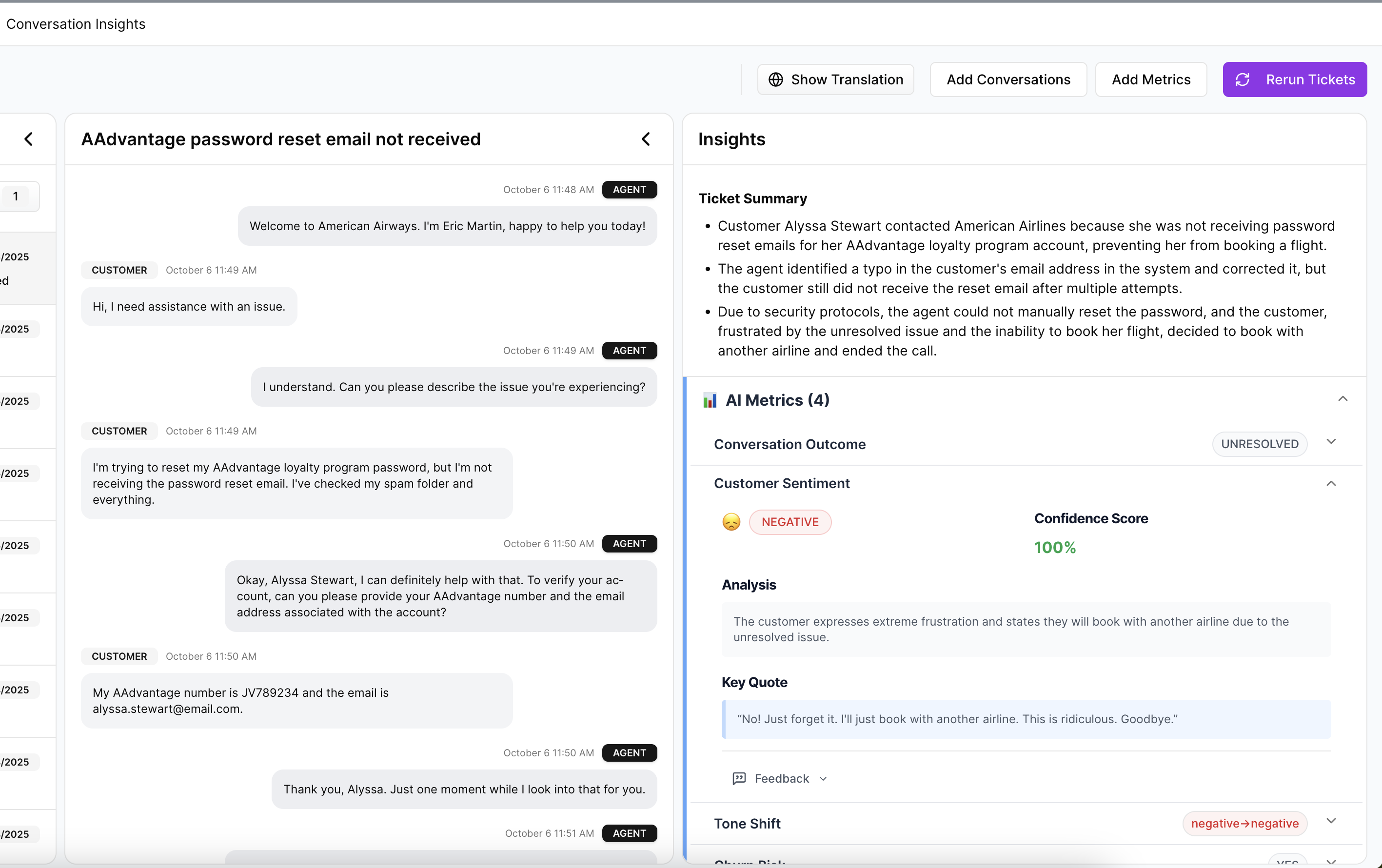
Analyze every conversation, not a slice. Then make each metric clickable down to the exact ticket and quote. That traceability is your audit trail in leadership and product reviews. It ends the “is this real” debate. It also speeds coaching, since you can jump from chart to transcript in seconds.
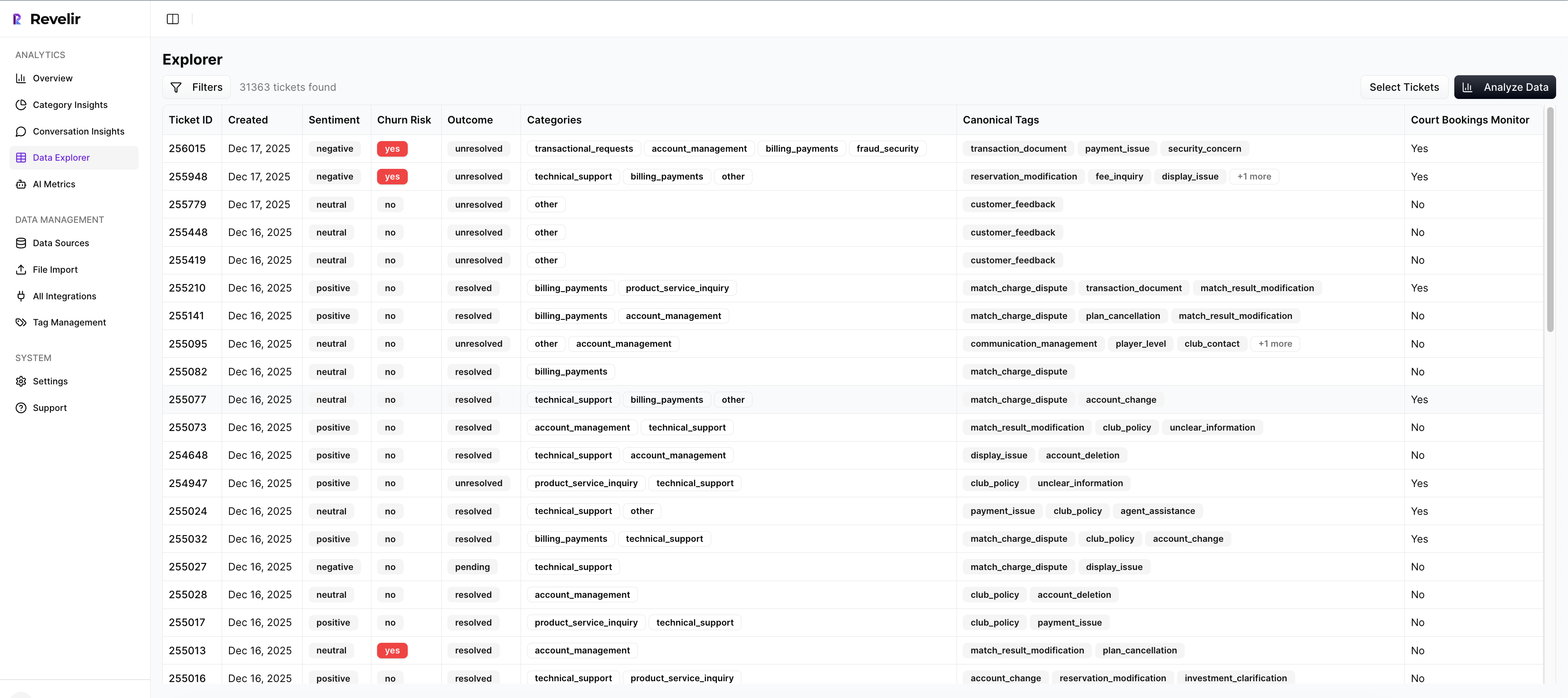
I’d argue traceability is the unlock. Without it, even good insights struggle to move work.
Standardize Drivers, Then Add Custom Metrics
Use a hybrid tagging model. Let AI surface raw, granular tags. Map those into a human-friendly canonical taxonomy that leaders recognize. Now you can report on “Billing” with clarity, while preserving detail like “proration confusion” for action. Next, define custom AI metrics that speak your language, for example, “churn mention,” “upsell opportunity,” or “refund request.”
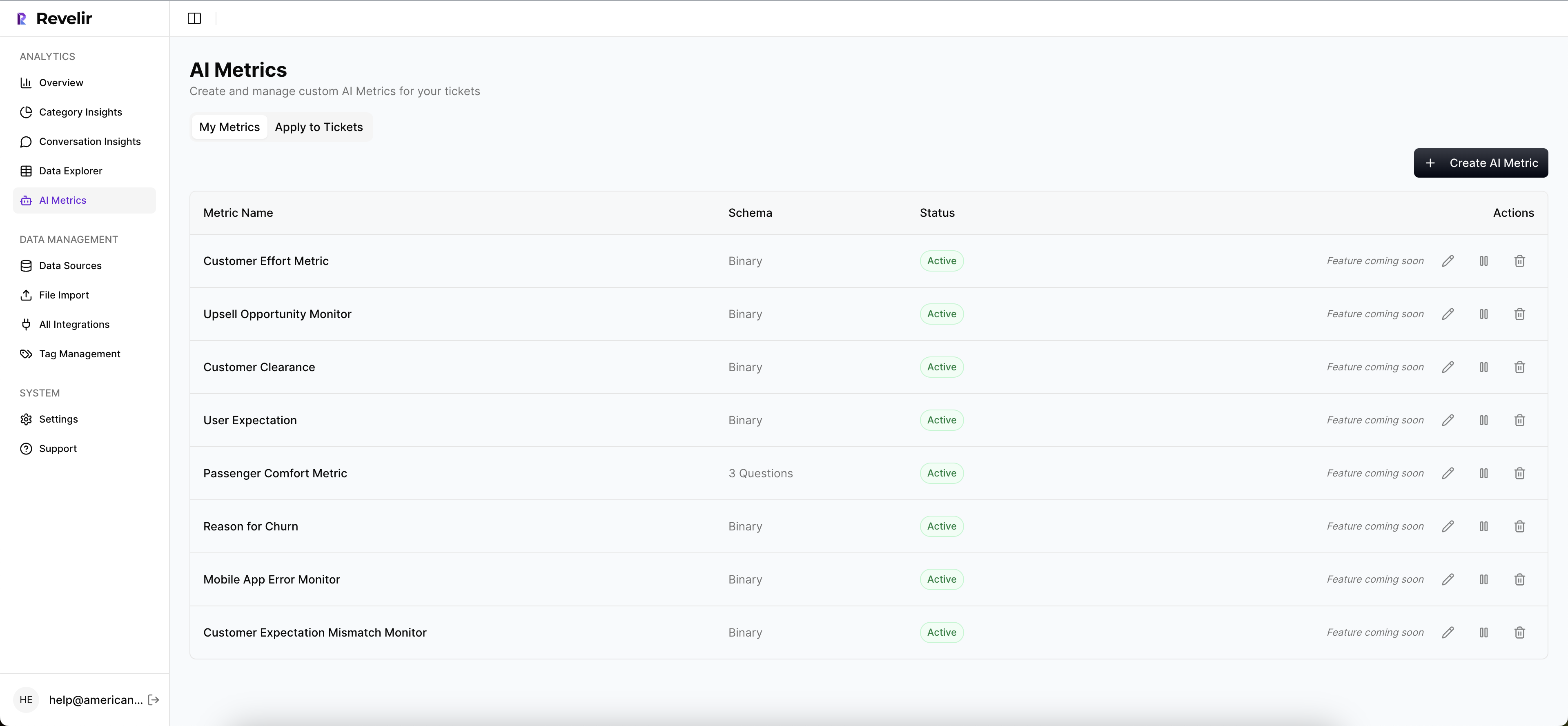
With that foundation, the work becomes practical. You can answer “why churn rose in enterprise last month” in minutes, with evidence that stands up in the room.
A simple way to implement the approach:
- Measure a 30-day baseline across 100% of tickets, grouped by drivers and segment.
- Define two or three custom metrics that matter for your business.
- Prioritize one fix that reduces effort for a high-value cohort.
- Ship, then re-measure the same driver stack the next month.
Stop guessing about churn. Start measuring drivers with evidence you can trust. Learn More
How Revelir Turns Support Conversations Into Retention Metrics
Revelir enables the approach above by processing 100% of your tickets, computing AI metrics, and linking every chart to the source conversation. The platform standardizes drivers with a hybrid tagging system, then gives CX and product teams a pivot-table-like workspace to explore patterns and pull quotes on demand.

Evidence-Backed Coverage, No Sampling
Revelir’s Full-Coverage Processing ingests every ticket from Zendesk or CSV, so you never risk missing the rare, high-cost pattern. The AI Metrics Engine computes sentiment, churn risk, effort, and outcome automatically, which becomes filterable columns across your dataset. Every aggregate is traceable to Conversation Insights, where transcripts and AI-generated summaries speed validation.
This traceability matters when you face the budget slide. You can show the exact tickets behind a driver, prove the cost, and get the fix funded. The hours once lost to manual reviews become minutes in Data Explorer.
From Drivers to Decisions, Fast
The Hybrid Tagging System combines AI-generated raw tags with human-aligned canonical tags, so you keep nuance without losing clarity. Drivers group those tags into leadership-friendly themes like Billing or Onboarding, which Analyze Data rolls up by segment, plan, or time window. With Custom AI Metrics, you label signals in your own language, then sort and group them like any other column.
Practically, this is how teams cut waste. Instead of debating a “negative trend,” you filter “Enterprise, Negative, High Effort, Billing: proration,” grab five quotes, and the roadmap writes itself.
Revelir’s core capabilities that reduce churn risk:
- Full-Coverage Processing, so hidden churn drivers are never missed.
- Hybrid Tagging System with Drivers, so findings translate into action.
- AI Metrics Engine and Custom AI Metrics, so you track what actually matters to your business.
- Data Explorer and Analyze Data, so teams move from chart to ticket in seconds with pivot-like speed.
- Evidence-Backed Traceability, so every metric stands up in exec and product reviews.
Want to see the workflow end to end, from ingest to decision? See how Revelir AI works
Tie Back to the Costs You Care About
Earlier, we called out two big costs: missed patterns and manual review time. With Revelir, grouped analysis finds churn drivers by cohort in minutes, not hours, which reduces rework on the roadmap. And because every insight links to the exact ticket and quote, you skip the “prove it” ping-pong that burns cycles across CX and product.
You won’t fix churn with vibes. You’ll fix it with evidence that earns action. That’s the shift.
Ready to pressure-test this on your own tickets with zero workflow change? Get started with Revelir AI
Conclusion
Churn is not a mystery. It is the sum of a few repeatable support moments that feel hard or unfair. Measure 100% of conversations, standardize drivers, add custom metrics in your language, and make every chart traceable to tickets. Do that, and you will see exactly why customers leave, who is at risk, and what to fix first. The rest is execution.
For definitions and baseline terms you can align on with finance and analytics, see Gartner’s churn rate glossary: Gartner: Churn Rate.
Frequently Asked Questions
How do I analyze support tickets for churn drivers?
To analyze support tickets for churn drivers, start by using Revelir's Data Explorer. This tool allows you to filter and group tickets based on various metrics like sentiment, churn risk, and effort. You can also drill down into specific tickets to see the underlying conversations. By examining these details, you can identify patterns that indicate why customers may be churning. Make sure to categorize issues using the Hybrid Tagging System to ensure clarity in reporting.
What if I want to track specific customer issues over time?
If you want to track specific customer issues over time, you can set up Custom AI Metrics in Revelir. This allows you to define metrics that matter to your business, like 'billing confusion' or 'onboarding issues.' Once set up, you can regularly analyze these metrics in the Data Explorer to see trends and changes, helping you prioritize fixes that can reduce churn.
Can I integrate Revelir with my existing support system?
Yes, Revelir can integrate directly with your existing support system, such as Zendesk. This integration allows for seamless ingestion of historical and ongoing tickets, including all relevant data like transcripts and tags. Once integrated, Revelir processes 100% of your tickets, ensuring you have comprehensive coverage without the need for manual exports.
When should I re-measure after implementing fixes?
You should re-measure after implementing fixes typically after a 30-day period. This allows you to gather enough data to see if the changes have had a positive impact on churn rates. Use Revelir's Analyze Data feature to summarize metrics and compare them against your baseline to assess the effectiveness of your interventions.
Why does manual ticket review create issues?
Manual ticket reviews can create issues because they often lead to bias and missed patterns. When you only sample a portion of tickets, you risk overlooking critical signals that indicate churn risk. With Revelir's Full-Coverage Processing, you can analyze every ticket, ensuring that no important insights are missed. This comprehensive approach helps you make informed decisions based on complete data.