

Two weeks is too long to move from “we found a pattern in support” to “someone owns the fix.” If you’re trying to embed AI conversation insights into the business, that lag is usually the real problem, not the model quality.
Most teams think insights become action once the slide deck is good enough. They don’t. The handoff breaks because nobody set up the ritual, the trigger, the evidence pack, or the owner. Same thing with support data. Same thing with product feedback.
Key Takeaways:
- If you want to embed AI conversation insights, start with a weekly decision ritual, not a dashboard rollout.
- Sampling support tickets creates false certainty. A practical threshold is simple: if you're reviewing less than 80% of conversations, you're managing risk with blind spots.
- Use a trigger-to-owner flow: metric spike, evidence pack, prioritization score, named owner, 48-hour action SLA.
- Traceability matters more than presentation polish. If a chart can't link back to real tickets and quotes, it won't survive leadership review.
- The best prioritization model balances three inputs: volume, severity, and ARR exposure.
- Custom taxonomy beats generic sentiment-only reporting when you need product and CX teams to act on the same signal.
- You don't need a new helpdesk to do this. A layer on top of Zendesk or a CSV export is enough to get started.
Why most AI conversation insights die in meetings
AI conversation insights usually die in meetings because they enter the business as observations, not decisions. The issue isn't that teams can't detect patterns. It's that the pattern arrives without a trigger, without a threshold, and without a defined path to action.

At 8:12 a.m. on Monday, a support ops manager is in Google Slides pulling in a Zendesk export before the weekly review. Negative sentiment is up 14%, onboarding complaints show up in 37 tickets, and two enterprise accounts used the phrase “we may pause rollout.” The room sees the slide, but nobody knows whether that number crosses a line, whether product owns validation, or whether CX should escalate it that day. By Friday, three more tickets pile up and the issue is still floating around as “interesting.”
That’s the core failure. Teams don’t fail to find patterns; they fail to convert patterns into commitments. And once you see that, the next question changes from “how do we get better AI?” to “what operating rule makes people act?”
Dashboards don't create decisions
A dashboard can show motion. It can't force commitment. That's the first reframe teams usually miss when they try to embed AI conversation insights into product and CX workflows.
I've seen this over and over. A support ops manager exports a few charts from Zendesk, maybe adds some sentiment labels from another tool, and drops it into a weekly slide deck. Product nods. CX nods. Somebody says, “we should look into that.” Then a week goes by. Nothing changes. The metric existed, but the decision mechanism didn't.
Call this the Meeting Fodder Trap. If an insight enters the room as “interesting,” it leaves the room as “later.” If it enters as “this crossed a threshold, here are the affected segments, here are five tickets proving it, and here's the owner we need by Wednesday,” now you're in business.
Sampling makes weak insights look stronger than they are
At 1,000 tickets a month, a 10% sample still leaves 900 conversations unreviewed. That is not prudence. That is selective vision with a spreadsheet attached.
A small subset of tickets can absolutely give you a story. Fair enough. For early-stage teams under 100 tickets a week, manual review still has real merit because humans catch nuance models can miss. But once ticket volume climbs and the organization wants to embed AI conversation insights into planning, nuance without coverage turns into anecdote with executive formatting.
The mechanism matters here. Scores tell you something moved. Full-text conversation analysis tells you why it moved, which customers are affected, and whether the pattern clusters around billing, onboarding, permissions, or performance. That’s why the broader shift toward full-text analysis keeps showing up in enterprise CX tooling and operating models, including the move described by McKinsey on generative AI and customer operations. If you only sample, you’re basically trying to diagnose a production outage by looking at one server log out of ten. Useful for a hunch. Dangerous for a decision.
The emotional cost is slower than the business cost
What does this feel like inside the building? Like rerunning the same incident postmortem every Tuesday without ever shipping the patch.
Support leaders feel it before the spreadsheet shows it. Product asks for cleaner proof. CX asks for faster action. Ops wants one version of the truth. Nobody fully trusts the inputs, so everyone asks for one more cut of the analysis. Not dramatic. Just draining.
That creates a weird kind of learned helplessness. Teams stop pushing insights because they assume the answer will be “bring more evidence.” Then nobody's checking the actual conversations at scale, and the same preventable issues keep coming back. If the old workflow turns signals into meeting artifacts, what decision system actually gets fixes shipped?
The real problem isn't analysis, it's missing decision mechanics
The real problem isn't that AI can't analyze support conversations. It's that most companies never build the operating system around those insights. They buy analysis, then skip orchestration.
That sounds abstract, but it isn't. You can see it in the handoffs. Alerts fire, charts get shared, teams agree something's off, and then the signal just sits there. Not because people don't care. Because nobody defined the rule for what happens next. The missing piece is not another model pass. It’s a default decision path.
Use the 48-Hour Embed Rule
If you want to embed AI conversation insights into the business, use what I'd call the 48-Hour Embed Rule: if a signal crosses an agreed threshold, it must have a named owner and next action inside 48 hours. If it doesn't, you don't have an insight workflow. You have a reporting workflow.
That’s a harsh line, I know. It can feel unrealistic for organizations with crowded backlogs or shared ownership across product and CX. Fair point. But the 48-hour clock is not a deadline to solve the issue; it’s a deadline to assign the issue. That distinction is why the rule works.
A practical version looks like this:
- A metric crosses a threshold.
- The team validates it with ticket evidence.
- The issue gets a priority score.
- One team owns the next move.
- The result gets reviewed the following week.
Simple. But not easy. Most orgs skip step 3 and wonder why product says no.
Build from drivers, not from scores
Sentiment is a flashlight, not a blueprint. Useful for spotting motion. Useless for building the fix by itself.
Negative sentiment is helpful, but it's not a roadmap. If you can't group conversations into meaningful drivers like billing, onboarding, account access, or performance, you end up telling product that “customers seem frustrated.” Nobody can build against “frustrated.” They can build against “new users are getting blocked in step two of onboarding after a permissions change.”
This is where the Driver Ladder helps. Start with broad drivers for leadership. Under that, map canonical tags that match internal language. Under that, keep raw tags to catch new patterns early. Before, the room debates whether the signal is “real.” After, the room debates which team should fix onboarding permissions first. Much better argument.
Traceability is the trust layer
Imagine two insight systems walking into the same product review. One has prettier charts. The other has linked quotes, source tickets, and a clean path back to the transcript. Only one survives the first skeptical PM.
CX can believe the model is directionally right and still lose the argument if product asks, “show me the tickets.” So the rule is blunt. No traceability, no action. If a chart can't be traced back to source conversations and quotes, it isn't ready for prioritization.
There is a legitimate case for moving fast with directional signals first, especially in a small company with low volume. That exception is real. But once you’re asking product, ops, or leadership to move resources, “trust us” stops working. So what does a working system look like when you actually try to embed AI conversation insights into weekly operations?
A practical system to embed AI conversation insights every week
A working system for AI conversation insights has four parts: trigger, evidence pack, prioritization, and SLA. That's it. Not twelve dashboards. Not a giant research program. Four parts that repeat every week until the behavior becomes normal.
This is the section most teams skip because it sounds operational. Honestly, that's the whole point. Insights don't become durable through inspiration. They become durable through ritual. And ritual is how you embed AI conversation insights without turning the whole thing into a side project.
Start with a trigger threshold, not a vague review
Before you prescribe fixes, diagnose the maturity of your review process. Ask four questions: Do we have numeric thresholds or just gut feel? Can we name the affected segment in under 30 seconds? Can we pull five supporting tickets immediately? Does someone own the next action by the end of the meeting? If you answered “no” to two or more, you don’t have an insight operating system yet.
The first thing you need is a threshold that pulls an issue into review automatically. I like the 3x3 Trigger Framework: three threshold types, checked in one weekly rhythm.
The three threshold types are:
- Volume spike: a driver or tag increases 25% week over week.
- Severity spike: churn risk, negative sentiment, or customer effort worsens by 15% or more.
- Exposure spike: the issue starts showing up in a high-value segment, strategic account set, or a cohort you care about.
If a pattern trips two of the three, it goes into the evidence pack. If it trips only one, watch it for another cycle. That rule keeps the team from thrashing on noise while still catching real change fast.
A concrete example helps. Say billing complaints rise 12%, but negative sentiment stays flat and the issue is isolated to low-value accounts. Watch list. Different story if onboarding friction rises 18%, customer effort turns high, and half the affected tickets come from new enterprise accounts. That gets pulled into review now.
Package evidence so the room can't wiggle out of it
Five minutes is the ceiling. If your evidence pack needs twenty slides, the room will negotiate with the formatting instead of the problem.
The evidence pack should answer four questions in under five minutes: what's happening, who it affects, why it matters, and what proves it. I use a simple pack shape:
- one headline metric movement
- one affected segment
- one driver or canonical tag cluster
- three to five representative ticket quotes
- one recommendation for owner and next step
This is where most reporting goes wrong. People bring charts without proof, or proof without scope. You need both. The chart gets attention. The quotes create trust. The segment framing forces priority.
This article from Revelir's own market point of view is right on the core idea: sampling and score-watching create false certainty because the “why” sits in the conversations, not in the aggregate alone. The broader trend is visible elsewhere too. Enterprise teams have moved toward using conversation data as a product signal, not just a support artifact, which lines up with how Gartner describes the growing role of customer service data in decision making.
Score issues with the VSA rubric
What wins when three teams all think their issue matters most? Usually the loudest stakeholder. Unless you replace volume of opinion with a scoring rule.
The one I like here is VSA: Volume, Severity, ARR exposure. Score each dimension from 1 to 5:
- Volume: how many conversations are affected?
- Severity: how painful is it, based on churn risk, effort, or strongly negative sentiment?
- ARR exposure: how much revenue sits inside the affected segment?
Multiply severity by two. That's the part teams often underweight. A smaller issue among high-value customers with strong churn language can matter more than a broad but mild annoyance.
Then add a validation gate. No issue gets into backlog review unless it has:
- At least five supporting tickets
- A stable driver or canonical tag cluster
- At least one quote a PM could read in 30 seconds
- A named segment or cohort attached
That's the Validation Gate Model. If the issue fails one of those checks, it stays in monitoring. Harsh? Maybe. Useful? Definitely.
Run a weekly ritual with hard SLAs
Monday-to-Tuesday is where this either becomes a business habit or stays a thought experiment. Timing matters more than elegance.
Here's a rhythm that works:
- Monday morning: refresh the review set.
- Monday afternoon: prepare the evidence pack.
- Tuesday review: score and assign.
- Wednesday: owner confirms next action.
- Following Tuesday: check whether action happened and whether the signal moved.
If you're serious about wanting to embed AI conversation insights, set a real SLA. Median time from signal detection to owner-assigned action should be under 48 hours. Fix confirmation should happen inside two sprints. Sentiment rollback or effort improvement should be checked within 14 to 30 days, depending on volume.
Know when not to operationalize a signal
Small signals and important signals are not always the same thing. That distinction saves teams from alert fatigue.
Use the 5-20 Rule. If a signal appears in fewer than 5 tickets, treat it as anecdotal unless the severity is extreme. If it appears in more than 20 tickets or touches more than 2 strategic accounts, it needs formal review. The middle zone gets watched for one more cycle.
We might be wrong about the exact numbers for every business. Fine. A B2B company with low ticket volume may need smaller thresholds. A consumer support org may need larger ones. But some threshold is non-negotiable. Without one, your insight process becomes mood-based. And once the ritual is clear, the tooling question gets much simpler.
How Revelir AI makes the ritual easier to run
Revelir AI fits this workflow because it doesn't ask you to rip out your support stack first. It connects through Zendesk Integration or CSV Ingestion, which is a much cleaner way to start if the goal is to analyze support conversations without creating another systems project.
That low-friction entry matters more than people admit. If onboarding turns into a platform migration, the insight ritual never gets off the ground. If you can plug into Zendesk or upload a CSV, teams can move from debate to evidence fast. The tool should act like a relay layer, not a replacement engine.
Revelir AI gives you evidence, not just charts
Revelir AI processes 100% of ingested tickets through Full-Coverage Processing, so you aren't stuck defending a sample in every review. That's the first big shift. Instead of saying, “we read a subset and think this is happening,” you can work from the full ticket set and reduce the representativeness argument before it starts.
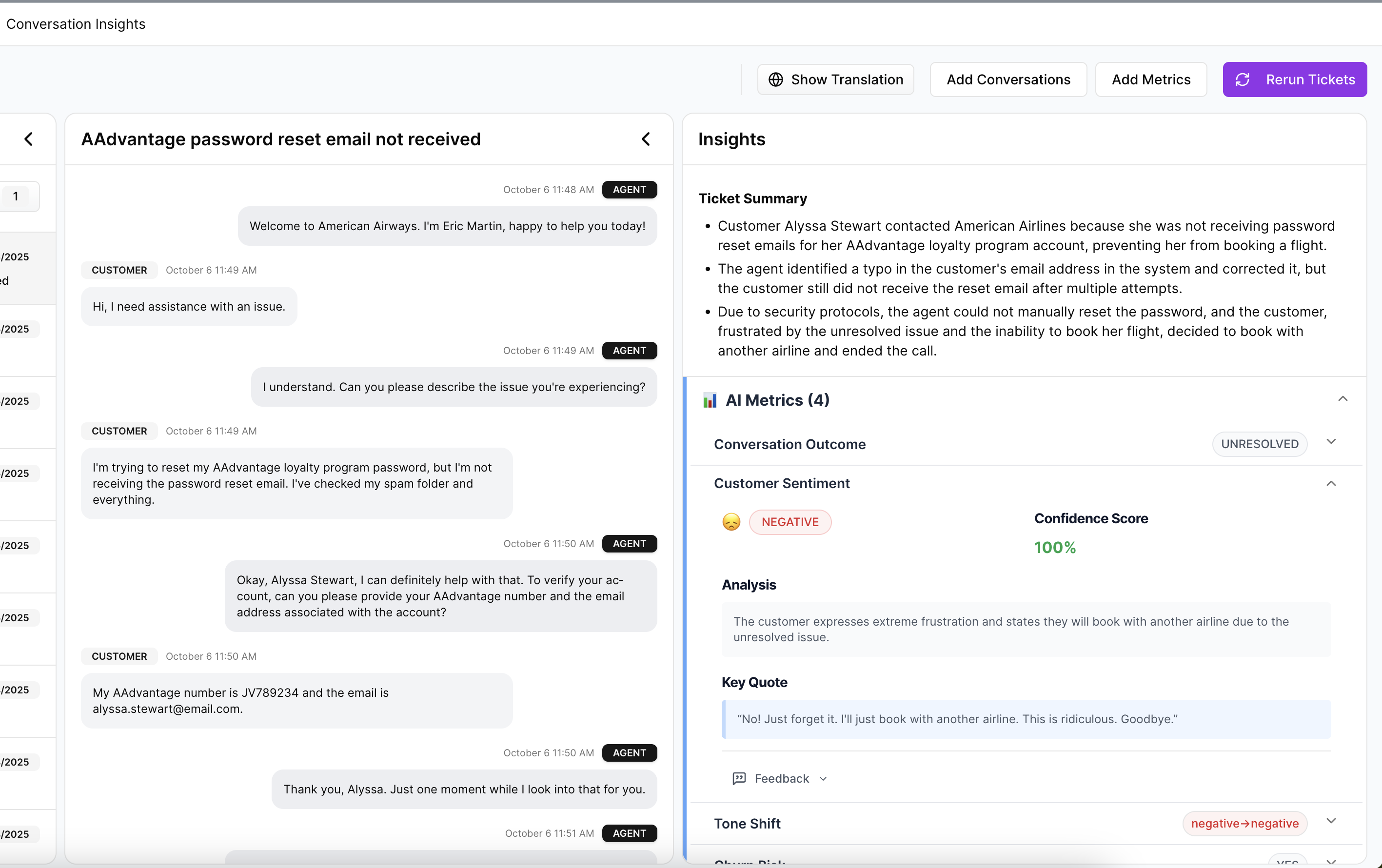
Then Evidence-Backed Traceability does the trust work. Every aggregate number links back to source conversations and quotes, which means a support lead, PM, or operator can drill from trend to transcript and validate what changed. Conversation Insights adds the ticket-level detail, including transcripts, AI-generated summaries, tags, drivers, and AI metrics, so the evidence pack is grounded in actual customer language.
That traceability callback matters because it directly attacks the old failure mode. The weekly review stops being “interesting chart, can anyone verify this?” and becomes “this metric moved, here are the tickets, here are the quotes, who owns the fix?”
Revelir AI supports the trigger and prioritization model
Tools usually fail here for a boring reason: they give you labels without structure or structure without evidence. You need both in the same workflow.
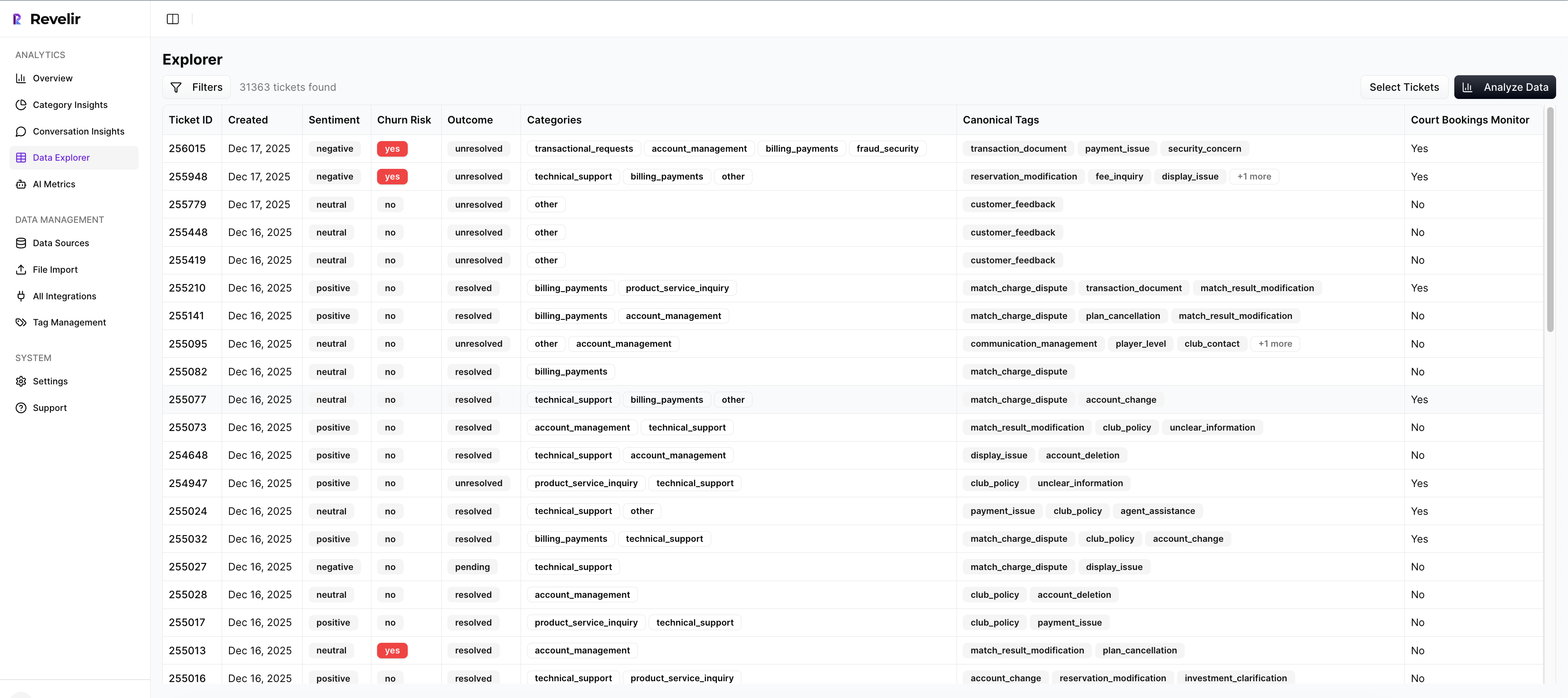
The workflow in this article depends on structured fields, and Revelir AI gives you those in a usable form. The AI Metrics Engine computes Sentiment, Churn Risk, Customer Effort, and Conversation Outcome as structured fields for filtering and analysis. Drivers give you the higher-level “why” layer leadership actually needs. The Hybrid Tagging System combines raw tags with canonical tags, which is useful because you need both discovery and reporting discipline at the same time.
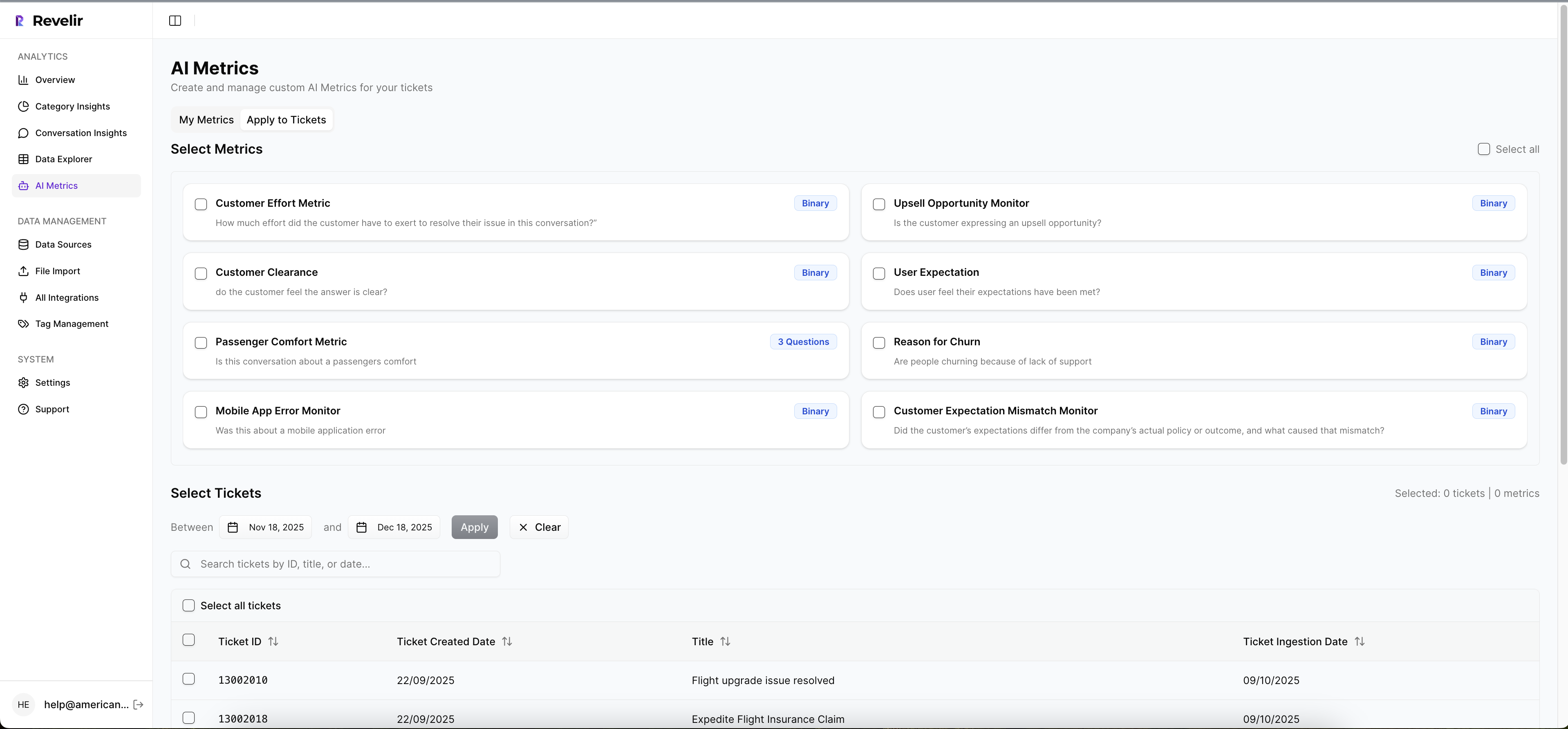
For teams with specialized operating language, Custom AI Metrics helps close the last-mile gap. You can define business-specific classifiers and use them as columns in filtering and grouped analysis, which is a much better fit than forcing every company into generic sentiment buckets.
Data Explorer and Analyze Data make the weekly mechanics easier. You can filter, group, sort, and inspect every ticket, then summarize metrics by Driver, Canonical Tag, or Raw Tag with linked drill-downs to the underlying conversations. And if you need to carry the structured results into existing reporting, API Export gives you that path. That's what makes Revelir AI useful here: not theory, but a practical way to run the trigger, evidence pack, and prioritization loop with full-ticket analysis and transparent traceability. Which leaves the only metric that really matters: how fast can your org move from signal to owner?
Cut the lag between signal and action
To embed AI conversation insights, you don't need prettier reporting. You need a ritual that turns signal into ownership fast. That's usually the missing piece.
Start with one weekly review, one threshold model, one evidence pack, and one hard SLA: under 48 hours from detection to owner-assigned action. If you can do that consistently, you'll stop collecting insight theater and start shipping evidence-backed fixes.
Frequently Asked Questions
How do I set up a weekly review ritual with Revelir AI?
To establish a weekly review ritual with Revelir AI, start by defining your trigger thresholds for insights. You can use the 3x3 Trigger Framework, checking for volume, severity, and exposure spikes. Next, prepare an evidence pack that includes key metrics, affected segments, and representative ticket quotes. Finally, schedule your review for a specific day each week, ensuring that actions are assigned within 48 hours of identifying an issue. This structured approach helps embed AI conversation insights into your regular workflow.
Can I integrate Revelir AI with my existing helpdesk?
Yes, Revelir AI can easily integrate with your existing helpdesk, such as Zendesk. This integration allows you to automatically ingest support tickets, including their metadata and conversation text, without needing to overhaul your current systems. You can also upload CSV files for historical data or testing. This flexibility helps you analyze support conversations efficiently and embed insights into your decision-making processes.
What if I have low ticket volume, how can I still use Revelir AI?
If you're dealing with low ticket volume, you can still effectively use Revelir AI by focusing on qualitative insights. Even with fewer conversations, Revelir's Full-Coverage Processing ensures that every ticket is analyzed, allowing you to capture nuanced feedback. You can also leverage the Custom AI Metrics feature to define specific classifiers relevant to your business, ensuring that you extract meaningful insights even from a smaller dataset.
How do I ensure traceability in my insights?
To ensure traceability in your insights with Revelir AI, make use of the Evidence-Backed Traceability feature. This capability links every aggregate number back to the source conversations and quotes, providing a clear path for validation. During your weekly reviews, present insights that include these direct links, so stakeholders can easily verify the data. This transparency builds trust and helps facilitate quicker decision-making.
When should I use the Data Explorer feature?
You should use the Data Explorer feature whenever you need to dive deep into your support tickets. It allows you to filter, group, and inspect every ticket, providing a comprehensive view of your data. For instance, if you're noticing a spike in negative sentiment, you can quickly analyze the underlying tickets to identify common themes or issues. This enables you to act on insights with confidence, ensuring that no critical patterns are overlooked.