

Dashboards are great for telling you what happened. They rarely change what agents do next. You get crisp charts, top drivers, a few spicy tags, and then… the same phrasing shows up in the queue tomorrow. It’s usually not a data problem. It’s an operating problem.
You need a bridge from insights to behavior. Evidence helps, but it’s not enough. Without a repeatable 1:1 cadence, clear micro-actions, and light documentation, feedback dies in the dashboard. This playbook makes the leap: from patterns to practice, from “good catch” to “better call.”
Key Takeaways:
- Stop relying on dashboards alone; translate drivers into observable behaviors and scripts
- Use full-coverage, traceable evidence to end debates and lower defensiveness in coaching
- Build a triage rubric (severity × frequency × customer impact) to prioritize coaching time
- Run weekly 30-minute micro-coaching with roleplays based on real transcripts
- Track CEM, repeat-contact rate, and sentiment shifts to verify coaching impact
- Use a simple record + script library to scale what works across managers and teams
Why Dashboards Do Not Change Agent Behavior
Most dashboards surface patterns; they don’t prescribe the next sentence an agent should say. Insights stall when teams lack a cadence that converts “Billing is spiking” into behavior change. The fix is operational: evidence-backed 1:1s, micro-actions, and short feedback loops. Example: driver trend → quotes → script tweak this week.

Why Do Insights Stall After The Dashboard?
If insights do not translate into coaching actions, nothing changes. The team celebrates “top drivers” and “spiky tags,” yet agents handle calls the same way next week. The real blocker isn’t awareness; it’s the absence of a ritual that turns patterns into practice. Nobody’s checking whether phrasing actually shifted on Tuesday.
We’ve seen the loop: analysis → share a chart → move on. Same thing with “insights emails.” Useful, but passive. You need a closed loop: a weekly 1:1 where the manager brings two tickets, identifies a behavior gap, practices new language, and documents three micro-actions. Without that muscle, charts become trivia.
Evidence Beats Anecdotes In The Coaching Room
Managers need verifiable examples to coach specific behaviors. Bring the transcript, highlight exact language, and pinpoint the escalation moment. When every coaching point is paired with a ticket example, defensiveness drops and specificity rises. Now you can practice new phrasing with context that feels real, not theoretical.
Ground your coaching in quotes and outcomes. Borrow proven manager techniques to make it stick, goal, reality, options, will, from resources like the Great Managers Playbook. You’re moving from “be more empathetic” to “start with this acknowledgement sentence when CEM is high.”
Stop Sampling, Start Traceable Signals
Sampling invites arguments about representativeness. Full-coverage metrics with traceable tickets end that debate. Start with 100% coverage of sentiment, Customer Effort Metric (CEM), churn risk, and drivers. Then drill into the tickets behind any spike, so every claim has an attached proof link.
Let’s be blunt: if you can’t show the quote, your insight won’t survive the meeting. Use traceability as a coaching accelerant. And when you deliver feedback, rely on practical phrasing frameworks like those in How To Give Constructive Feedback. Evidence opens the door; clear language walks through it.
Ready to move from patterns to practice? See the workflow end-to-end. See How Revelir AI Works
Bring Feedback Out Of The Dashboard And Into 1:1s
You operationalize insights by triaging signals into coachable behaviors, not just topics. A quick rubric scores severity, frequency, and customer impact, then maps top drivers to two behaviors and one escalation rule per driver. Example: “Billing” becomes confirm-understanding, clarify policy plainly, set a time-bound next step.

What Is Feedback Triage And Why Does It Matter?
Triage is how you sort feedback into coaching value. Create a fast rubric that scores issues by severity, frequency, and impact. Pull drivers from your analysis, score them, then translate top scores into behaviors to coach. This separates product fixes from frontline skills, so coaching time targets what agents can control this week.
It’s usually where teams slip: everything becomes a “coaching topic,” so nothing gets coached deeply. Use structured grouping by driver to reveal actual patterns, then focus your scarce 1:1 time. A motivating tone matters, see practical guidance in The Ultimate Playbook For Giving Feedback That Motivates And Corrects.
Map Drivers To Behaviors, Not Just Topics
A driver like Billing is not a behavior. Translate it into actions: confirm understanding, clarify the fee policy in plain English, set a resolution expectation, and define an escalation rule. For each driver, write two observable behaviors and one crisp escalation trigger. Now managers can coach, measure, and verify.
This reframes the conversation. Instead of “Billing is hot,” you’re practicing, “Start with: ‘I can see why that charge is confusing; here’s how it works in 20 seconds.’ Then confirm next step and time bound. If the account is enterprise + prior billing dispute, escalate.” That’s coachable. That’s measurable.
Define Priorities With Severity, Frequency, Customer Impact
Score each coaching opportunity 1 to 5 for severity, 1 to 5 for frequency, and 1 to 5 for customer impact. Multiply for a composite. Set a threshold that triggers coaching this week. Calibrate severity using distributions of sentiment, CEM, and churn risk by driver. Keep it simple; speed beats elegance here.
When the math says “coach now,” lock it into the 1:1 agenda. This avoids “favorite problems” and focuses on measurable reduction of effort and repeat contacts. Managers can explain the why, a composite score, not a hunch, so buy-in improves.
The Hidden Costs Of Unstructured Feedback On CX Metrics
Unstructured feedback inflates repeat contacts, rework, and debate time. Sampling delays detection; delayed detection increases escalations; escalations burn out teams. The tangible costs show up in handle time, backlog, and churn risk. Quantify it with simple math, then coach to the behaviors that reduce effort.
The Time Sink Of Repeat Tickets And Rework
Let’s pretend you handle 1,000 tickets monthly and 12 percent are repeats on the same policy confusion. At five minutes of rework per repeat, that’s 10 hours lost, before you count escalations and queue drag. Multiply by three months, then add the morale tax of fixing the same problem again.
Tie coaching to performance results so it sticks. For ideas on linking feedback to outcomes, see The Coach’s Playbook. You’re not coaching in the abstract. You’re reducing a known repeat-contact pattern with new language and clearer escalation thresholds.
The CEM And Repeat-Contact Penalty
High effort correlates with repeat contacts and churn risk. Identify drivers with elevated CEM, then coach behaviors that reduce back-and-forth. Examples: front-load context checks, confirm the next step with a time bound, and escalate proactively when churn-risk signals appear. Track repeat-contact rate and AHT for coached agents versus a matched cohort.
Measurement matters. A structure like the NICE Coaching Playbook helps teams define outcomes upfront, so your coaching isn’t just “better calls,” it’s fewer repeat contacts and a calmer queue.
Trust Erodes When You Cannot Show The Quote
Executives ask for proof. If you can’t show the transcript behind a metric, decisions stall and coaching plans lose credibility. Use evidence to shorten the debate: driver trend, metric distribution, then two representative quotes. Keep the focus on behavior change, not on whether the data is real.
Still stitching screenshots to justify a coaching plan? There’s a cleaner path. Learn More
When Coaching Fails, Everyone Feels It
Coaching gaps show up during incidents, in agent engagement, and with top accounts. Without scripts, rules, and practice, effort rises and confidence falls. Prepared teams codify escalation triggers, practice language, and shorten feedback loops. You can feel the difference in the queue and in the postmortem.
The 3am Incident You Did Not See Coming
A late-night outage spikes tickets. Agents scramble. Without a clear escalation rule and empathetic script, customers repeat themselves and effort rises. In the morning, leaders want answers. A documented playbook would have provided pre-approved phrasing, verification steps, and a clean handoff threshold. The absence is felt in every reply.
This is preventable. Use real transcripts from past incidents to practice the playbook in 1:1s. Decide the callback promise, the verification steps, and the “one-sentence expectation reset” ahead of time. You’re buying speed and calm.
When Your Best Agent Starts To Disengage
Coaching that feels punitive backfires. Agents shut down, avoid tough tickets, and cling to scripts that don’t fit the situation. Shift to growth and co-ownership. Show data and quotes, ask the agent to spot patterns, co-write micro-actions, and set a short review loop. Engagement returns when agency returns.
The tone is subtle but critical. You’re coaching with the work, not at the person. Celebrate what’s working first, then adjust one behavior at a time. Small wins compound; blame derails.
A Practitioner Playbook You Can Run This Week
Make this real in five workdays: build a triage rubric, run weekly micro-coaching, and translate insights into scripts and templates. Keep cycles short and measurable. Use real quotes so practice feels like the job, not roleplay theater.
Build A Triage Rubric That Converts Signals Into Coaching Priorities
Create a one-page rubric. Columns: driver, severity, frequency, customer impact, composite score, target behavior, escalation rule. Populate drivers from grouped analysis, then fill severity with CEM and churn risk context. Set a threshold that triggers coaching. Managers should score in minutes and act the same day.
Don’t overengineer. The rubric exists to make the top two coaching issues obvious, not perfect. Update monthly as patterns shift. Precision later; momentum now.
Run Weekly 30-Minute Micro-Coaching Sessions That Stick
Agenda: five minutes to review evidence and celebrate a win, fifteen minutes to roleplay two scenarios using real quotes, five minutes to write three micro-actions, five minutes to confirm metrics and the next check-in. Keep plans to three weeks. Short cycles build momentum and reduce drift.
You’ll notice agents start borrowing phrases that worked in practice. Capture those in your script library. Rinse and repeat next week with fresh evidence.
Translate Insights Into Micro-Actions, Scripts, And Measurement Templates
Write micro-actions that start with a verb and define a trigger. Example script skeleton: Acknowledge, Clarify, Confirm Next Step, Time Bound, Escalate If X. Attach a measurement template with baseline CEM, repeat-contact rate, and a sample of tickets to review weekly. Use a small A versus B cohort to isolate coaching effect over 8–12 weeks.
It’s usually the missing piece, measurement templates make coaching defensible. You can say, “We reduced repeat contacts by 18% on the coached driver,” instead of “It feels better.”
How Revelir AI Powers Evidence-Backed Coaching At Scale
Revelir AI turns messy tickets into structured, traceable signals you can coach against. Data Explorer surfaces where to focus, Analyze Data quantifies severity and frequency, and Conversation Insights ties every metric back to the exact quote. You move from dashboard trivia to repeatable, evidence-backed 1:1s.
Use Data Explorer To Triage And Target Coaching
Work from a single, structured view of tickets. Filter by sentiment, effort, and churn risk; group by drivers; and click into any segment to see the conversations behind it. This produces a defensible shortlist of coaching opportunities tied to the exact tickets you’ll use in 1:1 roleplays.
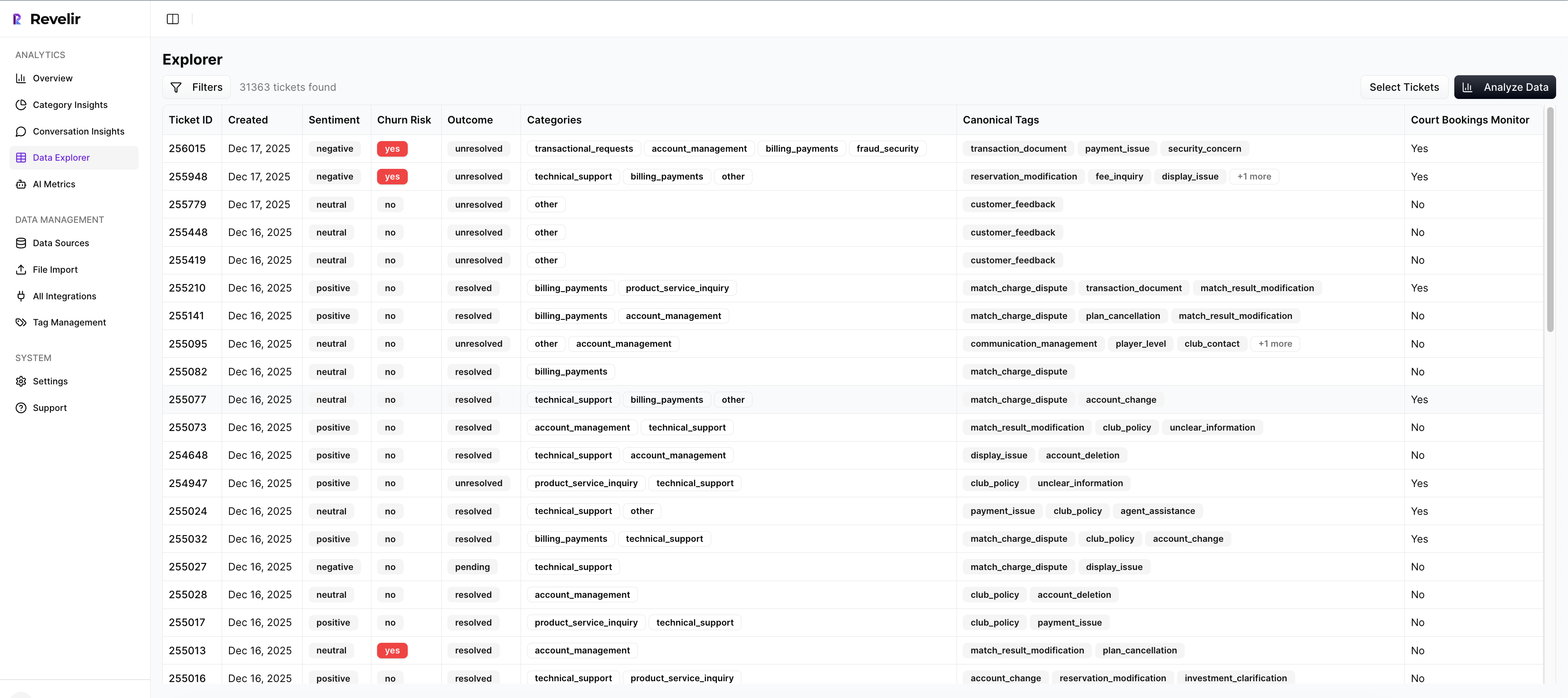
Revelir AI processes 100% of conversations, no sampling, so you’re not arguing about representativeness. You’re deciding what to fix and how to coach it, with confidence.
Use Analyze Data To Feed Your Rubric Inputs
Run grouped analyses like CEM by driver or sentiment by canonical tag. Export results into your rubric columns for severity and frequency. Because Analyze Data is built for tickets, the tables and stacked bars reflect your categories and drivers, not generic labels. Revisit weekly as patterns shift without rebuilding queries.
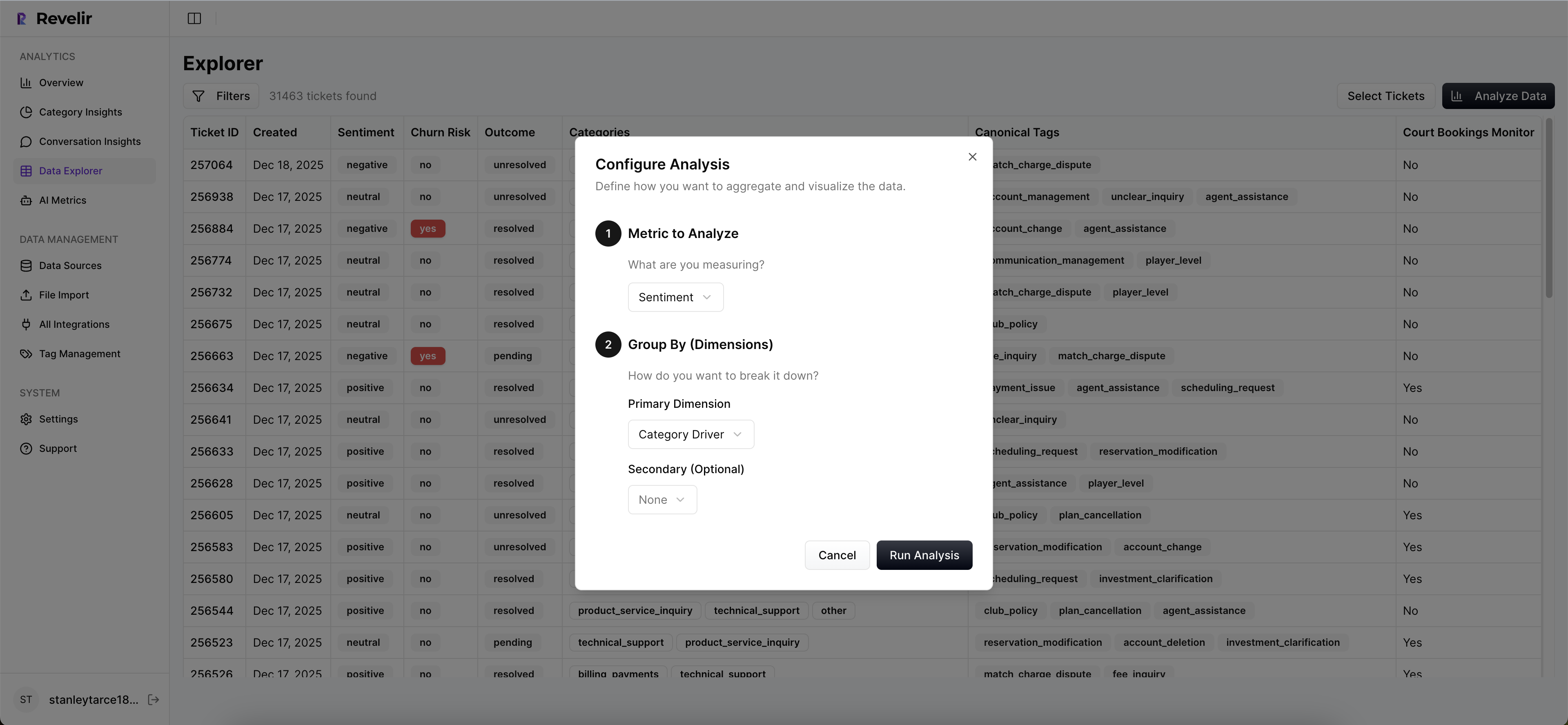
This is the connective tissue between insight and action: a consistent way to populate the rubric in minutes. Revelir AI keeps the analysis up to date as new tickets land.
Pull Quotes In Conversation Insights To Write Better Scripts
Click any count to open Conversation Insights for the exact tickets behind a trend. Grab representative quotes and AI summaries to craft scripts and roleplays. This traceability shortens meetings, reduces debate, and helps agents practice scenarios that mirror real customer language.
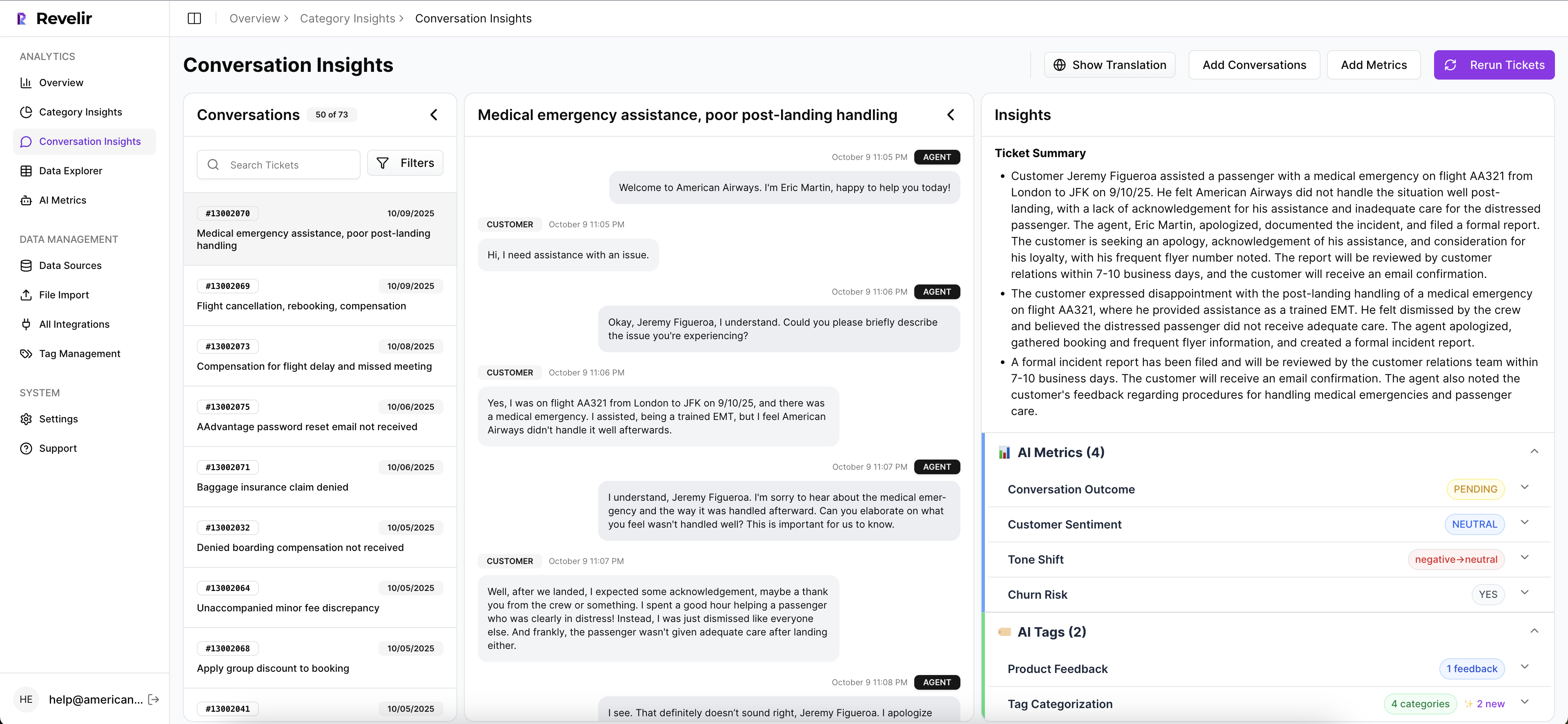
When you present to product or leadership, every slide has receipts. The drill-down is one click away. That’s how coaching plans earn trust, and budget.
Revelir AI is built for this workflow. Use Revelir AI to triage with Data Explorer, quantify with Analyze Data, and coach with Conversation Insights, always backed by 100% coverage and clear traceability to quotes. Let the platform handle structure and evidence so managers can focus on behavior change, not plumbing. Want to see the full loop? Get Started With Revelir AI
Conclusion
Dashboards explain what’s happening. Coaching changes what happens next. When you pair full-coverage, traceable evidence with a tight 1:1 cadence, micro-actions, and light documentation, agents shift their language, effort drops, and repeat contacts fall. Build the rubric, run the sessions, measure the change. Evidence in, better calls out.
Frequently Asked Questions
How do I prioritize coaching topics using Revelir AI?
To prioritize coaching topics effectively, start by using Revelir AI's Data Explorer to filter tickets by sentiment and churn risk. Look for high-volume issues that also show negative sentiment. Once you identify these, create a triage rubric that considers severity, frequency, and customer impact. This way, you can focus your coaching efforts on the most pressing issues that affect customer experience. Regularly review these metrics to adjust your coaching priorities as new data comes in.
What if I want to track the impact of coaching sessions?
To track the impact of your coaching sessions, use Revelir AI's metrics like Customer Effort Metric (CEM) and sentiment analysis. After each coaching session, monitor these metrics over time to see if there's a positive shift in customer interactions. You can also filter your data to focus on specific agents or topics and analyze trends in their performance. This will help you validate the effectiveness of your coaching and make necessary adjustments.
Can I customize the metrics used in Revelir AI?
Yes, you can customize metrics in Revelir AI to better align with your business needs. You can define custom AI Metrics that reflect specific aspects of customer interactions, such as 'Upsell Opportunity' or 'Reason for Churn.' This allows you to tailor the insights to your unique context. Additionally, you can refine your canonical tags and drivers over time to ensure they capture the most relevant themes in your support conversations.
When should I use the Analyze Data feature?
You should use the Analyze Data feature in Revelir AI whenever you need to gain insights from your ticket data quickly. This tool is particularly useful for answering questions like 'What’s driving negative sentiment?' or 'Which issues are most associated with high churn risk?' By selecting relevant metrics and grouping by dimensions, you can get a clear view of patterns in your data, helping you make informed decisions about coaching and operational improvements.
Why does my team need 100% coverage of support tickets?
Your team needs 100% coverage of support tickets to avoid missing critical insights that can lead to churn or operational issues. Relying on sampled data can create biases and delay the detection of problems. With Revelir AI, every conversation is analyzed, ensuring that you capture all relevant signals, such as frustration cues and churn mentions. This comprehensive approach allows you to make data-driven decisions that are backed by real evidence, ultimately improving customer experience.