

Blanket discounts feel like a quick save. They’re not. They reset the relationship to “negotiate or threaten,” and they tell your team to skip the hard part, understanding what actually broke for the customer and fixing it. Evidence-led outreach does the opposite. It starts with their words, confirms the driver, and shows progress. Credibility first. Everything else gets easier.
Here’s the punchline: you don’t need more surveys or a new “retention playbook template.” You need to pull real quotes and drivers from 100% of support conversations and use them to guide who you email, what you say, and how you measure lift in 30 days. It’s usually a data problem dressed up as a messaging problem.
Key Takeaways:
- Lead outreach with verifiable ticket quotes tied to clear drivers, not generic apologies or discounts
- Build a 30-day cohort from complete coverage using churn risk, sentiment, effort, and driver density
- Prioritize accounts by volume × severity × ARR to focus CSM time where it moves retention
- Personalize with the customer’s own words, then propose a concrete, observable remedy
- Measure weekly deltas in driver density, sentiment, and churn risk for contacted accounts
Ready to skip the theory? See how an evidence-first workflow looks end to end. See How Revelir AI Works
Why Evidence-Led Outreach Beats Blanket Discounts (And Saves More Accounts)
Evidence-led outreach reduces churn by replacing guesswork with the customer’s own words and the specific driver behind them. When you anchor outreach in quotes and fixes, you lower defensiveness and move the conversation from price to progress. Teams that start with evidence see clearer next steps and faster resolutions.

Why Blanket Discounts Backfire On Retention
Discounts feel fast. They also train customers to escalate for concessions. When the opening move is price, you invite a negotiation instead of a solution. The result is lower ACV, more escalations, and a pipeline full of “we’ll revisit after the next incident.” Not the loop you want.
Open with what you know. “You said, ‘We keep hitting timeouts on invoice export.’ We found the driver and here’s what changed.” It’s specific and falsifiable. It shows you listened. The tone shifts from adversarial to practical. If a discount makes sense later, fine. But it’s not your first card.
What Is Ticket Evidence And Why Does It Build Trust?
Ticket evidence is simple: exact customer quotes plus the tags and drivers pulled from their conversations. Not a vibe. Not a summary deck. The real text, tied to structured context. When you say, “You mentioned payment failures during checkout; here are the steps we shipped and what to expect next,” the message lands.
This is where trust starts. Because nothing kills a renewal call faster than a vague “we’re sorry about the inconvenience.” Evidence gives the customer a reason to stay and leadership a reason to back your plan. Teams that apply this pattern alongside targeted messaging approaches, as discussed in Outreach’s churn guidance, avoid the discount-first spiral.
The Outreach Open That Starts With The Customer’s Own Words
Start with a direct quote, mirror the driver, and propose a next step. Keep it brisk. One or two lines to acknowledge, one line to describe the fix or action, one clear ask. Short, specific, and tied to a path forward beats long apologies every time.
A simple opener: “You wrote, ‘We keep hitting timeouts on invoice export.’ We analyzed similar tickets and identified a configuration issue we’ve corrected. Can we walk you through the change and confirm it’s resolved on your side?” That structure compresses back-and-forth and moves you toward resolution.
The Operational Gap Between Signal And Action
The gap isn’t “we don’t have data.” It’s that health scores and dashboards don’t tell a CSM who to contact today, what to say, or how to track lift. You need a bridge from ticket-level metrics to a 30-day action plan, cohort, scripts, tasks, and measurement, so outreach actually happens and holds up under review.

What Traditional Risk Scoring Misses In The Last Mile
A red account score is a headline, not a plan. Health index down two points, now what? Without driver-level detail and copy-ready quotes, CSMs end up hunting across tools, rewriting context, and guessing on message framing. Momentum dies in the gap between awareness and action.
You want this to be boringly repeatable: “If churn risk = yes or driver density spikes, auto-queue the account, pre-load quotes, suggest a driver-specific opener.” Same thing with measurement. Define the outcome before day one. If it’s not measurable in 30 days, it won’t survive prioritization.
Why 100% Coverage Matters For Cohort Accuracy
Sampling misses the quiet but costly patterns: onboarding friction, intermittent failures, policy confusion. If you only read 10% of tickets, you won’t see the emerging drivers that matter. Full coverage lets you filter by churn risk, effort, sentiment, and drivers across every conversation, then pivot by plan or region.
Cohorts built on complete data reduce false positives and protect CSM time. You outreach to accounts that will actually benefit, not just the loudest voices. This aligns with how mature teams structure repeatable playbooks, as described in Gainsight’s guidance on automating churn prevention playbooks.
The Hidden Cost Of Waiting To React
Waiting turns small friction into big retention problems. Time sinks, wrong-target outreach, and stalled approvals stack up quickly. The fix is removing the scavenger hunt: centralize metrics, make quotes one click away, and ship a weekly cadence that learns.
Hours Lost To Research And Copy-Paste
Let’s pretend a CSM spends 30 minutes per account stitching context across tickets, Slack, and BI. For a 60-account risk list, that’s 30 hours before a single email goes out. Do that monthly and you’ve burned weeks on detective work.
Centralized, filterable ticket metrics with drill-down to quotes eliminate the hunt. You go from “give me a day to read up” to “I have the quote and the driver; here’s the fix we’re proposing.” It’s usually the difference between a playbook that runs and one that stays in a deck.
The Revenue Drag Of Contacting The Wrong Accounts
Outreach to low-risk or non-renewing accounts is more than a time waste. It dilutes message quality, increases unsubscribe fatigue, and creates noise your leadership learns to ignore. The signal gets buried.
Build a cohort that blends churn risk flags, high-effort experiences, negative sentiment, and driver density. Then layer revenue impact. You’ll improve save rates and give executives a clean readout: fewer contacts, higher outcomes. Teams that operationalize cohort discipline mirror patterns you’ll see in resources like ChurnZero’s customer champion playbook.
Still hand-assembling risk lists each month? There’s a faster way to move from signal to action. Learn More
The Moment It Gets Real For Your Team
Churn risk spikes at human moments: champions leave, deadlines compress, unexpected friction hits. This is where evidence-led outreach earns its keep, because you can move inside 24 hours with specifics, not platitudes.
When Your Champion Leaves, Risk Jumps And Silence Follows
Champion departure changes everything. Suddenly the context walks out the door, and “we’ll reassess at renewal” enters the chat. Treat this as an immediate trigger: review the last 60 days of tickets, identify the top drivers, and assemble a two-quote brief for the new stakeholder.
Open with their reality. “In the past month, your team flagged high effort around account access and payment retries. We’ve made two changes and want to confirm they’re working on your side.” It’s respectful and concrete. You’re not asking for trust; you’re showing work.
What If You Could Reply With Proof Inside 24 Hours?
Imagine a high-value account opens three high-effort tickets this week. Within a day, you filter the exact set, confirm the driver, and send a two-line note with a quote and remedy. No scramble. No committee.
That’s the bar. You don’t need perfect accuracy; you need trustworthy, verifiable patterns and quotes on demand. The tone of the relationship shifts when you can say, “Here’s exactly what we saw, here’s what we changed, here’s how we’ll measure it this week.”
A 30-Day Evidence-First Outreach Playbook You Can Run This Week
A 30-day playbook starts with a precise cohort, prioritizes by impact, and uses the customer’s words to drive action. Define the triggers, commit to weekly reviews, and measure lift across driver density, sentiment, and churn risk. Keep it small enough to run without heroics.
Step 1: Define Your 30-Day Cohort With Precise Triggers
Start with full ticket coverage. Filter the last 30 days for churn risk = yes or combinations like two or more negative sentiment tickets, high-effort tickets, or rising driver density in key categories. Then layer metadata, ARR tier, plan, region, and save it as a standard view for weekly refresh.
Before you move, validate. Drill into five to ten tickets to ensure the cohort matches your intuition. If something looks off (it will occasionally), refine the driver mapping or filters. The point isn’t perfection; it’s removing obvious false positives so your team trusts the list.
Step 2: Prioritize Using A Volume, Severity, ARR Matrix
Not every risky account gets the same motion. Score each account weekly on three axes: volume of qualifying tickets, severity proxy using effort and driver types, and revenue impact via ARR. Then triage into sequences: Critical, Concern, Watch. Channels and cadences differ by tier.
This forces trade-offs. It also reduces context switching. CSM time maps to expected retention impact, and leadership sees a clean story: “We focused on 28 critical accounts representing 42% of at-risk ARR, with driver X and Y as primary causes.”
Step 3: Write Evidence-Led Scripts, Automate Tasks, And Measure Impact
Draft templates that open with a verbatim quote, mirror the driver, and propose the next step. Personalize subject lines with driver and outcome tags. Include one or two remedy bullets and a single ask. Keep a small library of driver-specific snippets you can slot in quickly.
Now automate the boring parts. Export your cohort and metrics to build CRM lists, tasks, and sequences. Set up A/B tests on subject lines and call-to-action framing. Define success before you start: response rate, meeting set rate, ticket resolution velocity, and 30-day retention signal deltas. Review weekly and tighten versions so you learn which message solves which driver.
How Revelir AI Powers Evidence-Led CSM Outreach
Revelir turns 100% of your support conversations into structured, traceable metrics that CSMs can use the same day. You get full-population coverage, a pivotable workspace to isolate drivers, one-click drill-down to copy-ready quotes, and export options to feed your CRM and reporting. The goal isn’t more dashboards. It’s decisions you can defend.
How Revelir AI Builds Your Risk Cohort From 100 Percent Of Tickets
Revelir ingests tickets via helpdesk integration or CSV, then applies AI metrics like sentiment, churn risk, and customer effort, plus any custom metrics you define. In Data Explorer, you filter the last 30 days and stack conditions to isolate your outreach cohort by plan, region, or ARR tier.
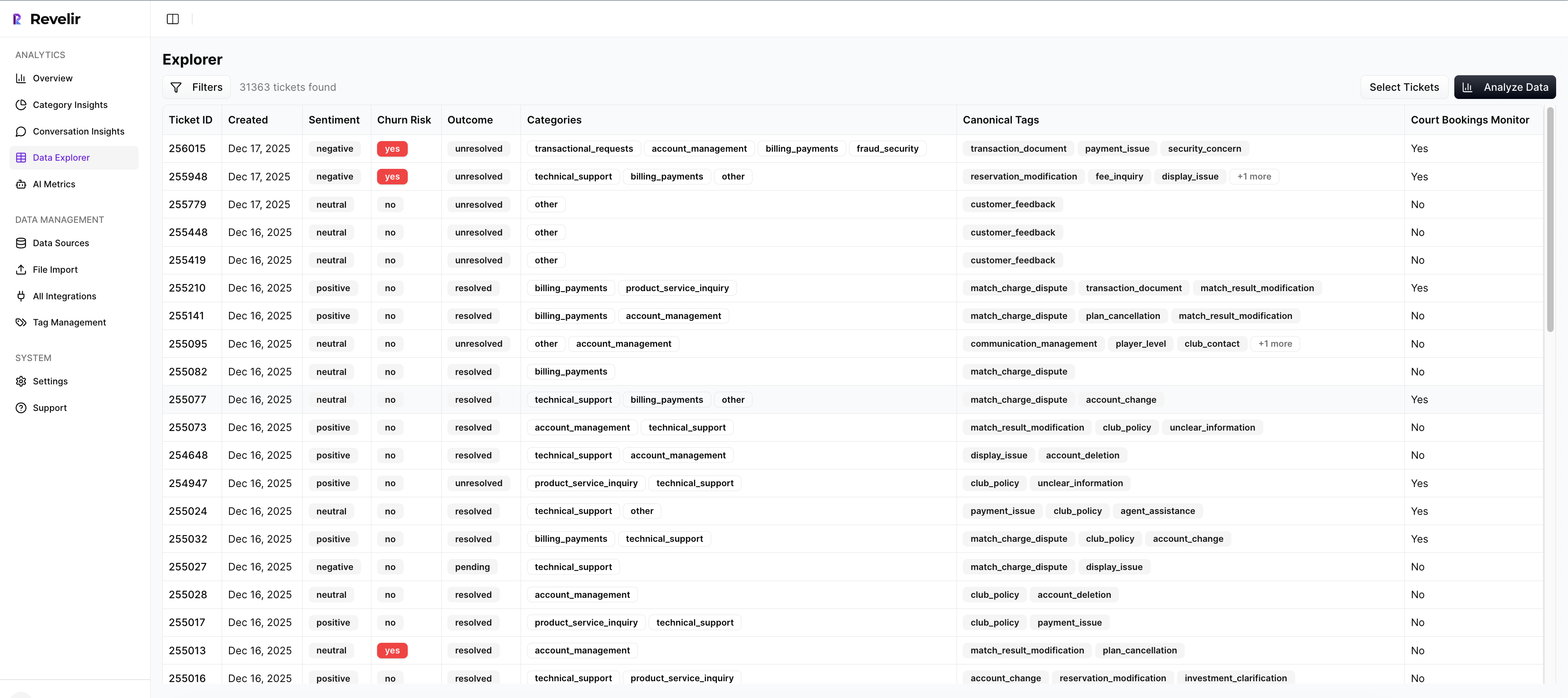
Because coverage is complete, no sampling, you avoid blind spots and catch early signals that sampling would miss. Save the cohort as a reusable view and it refreshes as new tickets arrive. This reduces the “30 hours of research” problem to minutes and turns your risk list into a living workflow.
How Data Explorer And Analyze Data Pinpoint The Drivers You Should Address
Inside Data Explorer, you can slice by drivers, canonical tags, and metrics in seconds. Click Analyze Data to group your cohort by driver or category and see which issues dominate negative sentiment or churn risk. The stacked bar chart and grouped table make patterns obvious, fast.
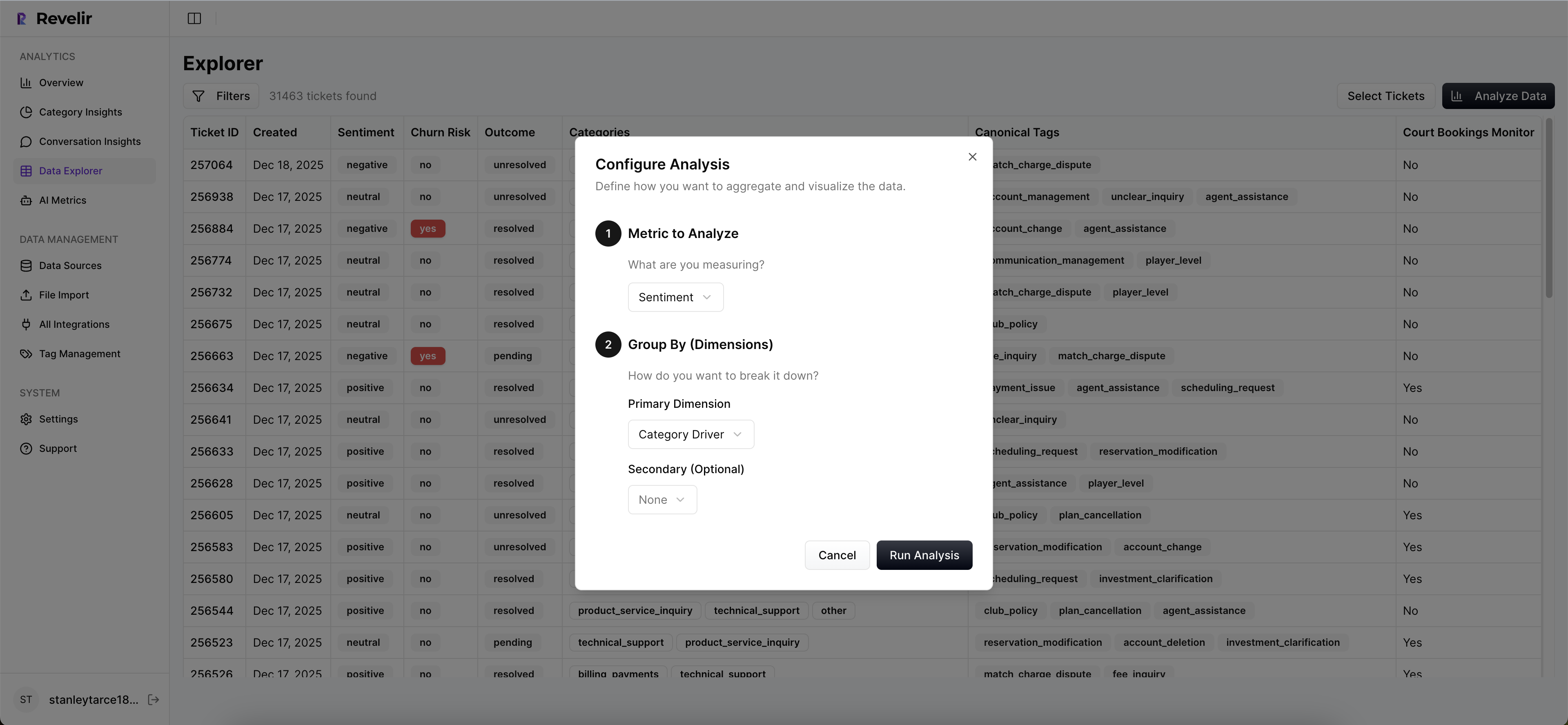
Then you validate. Click any row to see the underlying conversations, confirm the pattern, and pull representative quotes. This is where a generic “we’re sorry” email becomes a targeted, high-credibility note that references exactly what customers said, and what you’ve changed. If you want a market perspective on codifying these motions, see Zendesk’s take on success playbooks.
How Conversation Insights And API Export Close The Loop
From any slice, jump into Conversation Insights to read the transcript, review the AI summary, and inspect assigned metrics. Copy the precise quote to open your email or guide your call. Every chart is linked to source evidence, so the “show me where this came from” question is easy, even in executive reviews.
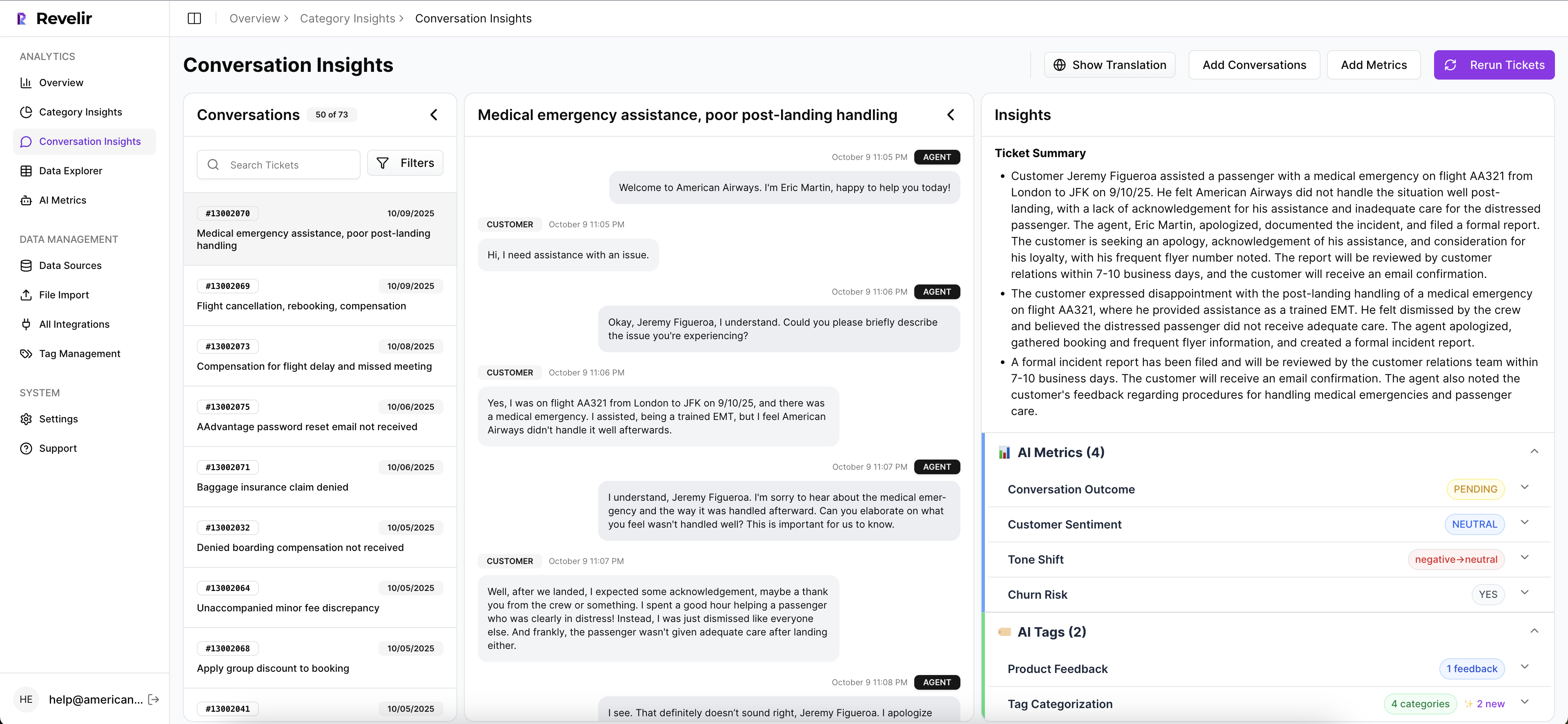
When it’s time to run the play, export cohorts and metrics via API or CSV. Build lists, tasks, and dashboards that mirror your tiers. Monitor week-over-week shifts in driver density, sentiment, and churn risk for contacted accounts. Revelir keeps the loop tight, from unstructured text to structured signals to measurable outcomes.
Want to see this workflow on your own data end to end? See How Revelir AI Works. Ready to operationalize evidence-led outreach with full coverage and traceability? Get Started With Revelir AI
Conclusion
You don’t prevent churn with one heroic save or another discount code. You prevent churn by turning every conversation into evidence you can act on, who to contact, what to say, and how to prove it worked. Lead with their words. Map drivers to fixes. Measure the lift in 30 days. When the evidence is visible, the renewal stops being a fire drill and becomes a formality.
Frequently Asked Questions
How do I prioritize accounts for outreach?
To prioritize accounts effectively, start by analyzing churn risk, sentiment, and effort metrics from your support tickets. You can use Revelir AI to filter and group tickets based on these metrics. For example, focus on accounts with high churn risk and significant negative sentiment. By combining these factors, you can create a prioritized list that directs your Customer Success Managers (CSMs) to engage with the accounts that need attention the most. This targeted approach often leads to better retention outcomes.
What if I need to validate insights from my data?
If you want to validate insights, use the Conversation Insights feature in Revelir AI. This allows you to drill down into specific tickets that contribute to your aggregated metrics. Start by filtering your data in the Data Explorer, then click on the relevant metrics to access the underlying conversations. By reviewing these tickets, you can ensure that the insights align with actual customer feedback, providing a solid foundation for your outreach strategies.
Can I customize metrics in Revelir AI?
Yes, you can customize metrics in Revelir AI to match your business needs. This is done through the AI Metrics feature, where you can define specific metrics that are relevant to your organization, such as 'Upsell Opportunity' or 'Reason for Churn.' By tailoring these metrics, you can ensure that the insights generated are aligned with your strategic goals, allowing for more effective decision-making and outreach efforts.
When should I use the Analyze Data feature?
You should use the Analyze Data feature when you need to gain insights into specific trends or issues within your support tickets. For instance, if you notice an increase in negative sentiment, running an analysis can help you identify the drivers behind this trend. You can group the data by various dimensions, such as churn risk or customer effort, to uncover actionable insights. This feature is particularly useful for making data-driven decisions about where to focus your retention efforts.
Why does sentiment matter in customer outreach?
Sentiment is crucial in customer outreach because it provides insight into how customers feel about your service or product. By analyzing sentiment metrics through Revelir AI, you can identify accounts that are dissatisfied or at risk of churning. This allows you to tailor your outreach efforts, addressing specific concerns and improving customer relationships. Engaging with customers based on their sentiment can lead to more meaningful conversations and higher chances of retention.